Organic Chemistry Tips and Tricks
9 Nomenclature Conventions To Know
Last updated: January 23rd, 2024 |
Chemical nomenclature can be frustrating to learn. It’s a series of conventions which have been patched together over a long period of time, some of which date back to the 19th century. The language contains archaic terms that are past their useful prime, but are lodged deeply in the language of chemistry and almost impossible to excise at this point. The point of this article is to go beyond the common terms cis, trans, (E,Z), (S,R) – which are an absolute must to know – to point out some of the less frequently encountered aspects of nomenclature which might make you furrow your brow and say – “what does that mean?”
1. Bracket notation.
- When it’s used: In condensed formulas.
- What it means: Signifies that a substituent is attached directly to the preceding carbon.
- Example: CH3C(O)CH2CH3 (2-butanone)
- Why it’s useful: Without the bracket, the structure would be written CH3COCH2CH3, which might be confused for an ether. The bracket makes it more clear that it’s a ketone.
- Notes: Although not exactly obscure, it’s an aspect of nomenclature that can lead to confusion.
2. n-, s-, and t-
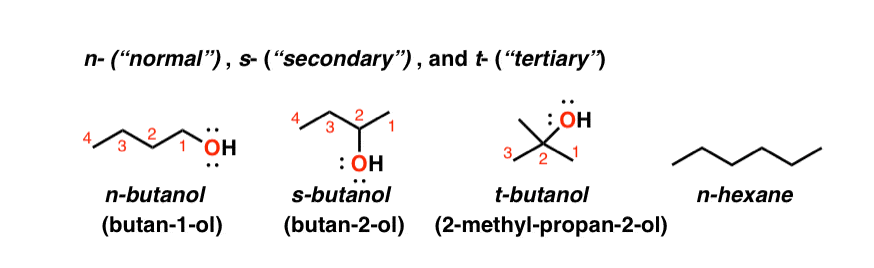
- When it’s used: for short chain alkanes and alcohols.
- What it means: n- means “normal” – an unbranched chain with the functional group (if present) on the 1-position. s– means “secondary”, t– means “tert“.
- Why it’s useful: Just a shorthand way of describing different structural isomers.
- Notes: n-hexane is another frequently encountered name, which simply represents a linear six-carbon chain. “Hexanes”, which you might see in the lab, refers to a mixture of different (branched) isomers of hexane.(it’s purified by distillation, and the isomers have very similar boiling points, so it’s sold as “hexanes”. Pure n-hexane is more expensive because separating it from its isomers is a royal pain).
3. The N- prefix
- When it’s used: for amines and amides.
- What it means: The N– signifies that the substitutent is connected to the nitrogen.
- Example: N-methyl butylamine, N,N-dimethylformamide.
- Why it’s useful: it removes ambiguity. “Methyl butylamine”, for instance, could refer to an isomer where the methyl group is on the carbon chain.
- Notes; when different substituents are present on the nitrogen, the terminology is N-(substituent),N-(substituent), for instance N-methyl,N-ethylbutylamine.
4. L and D
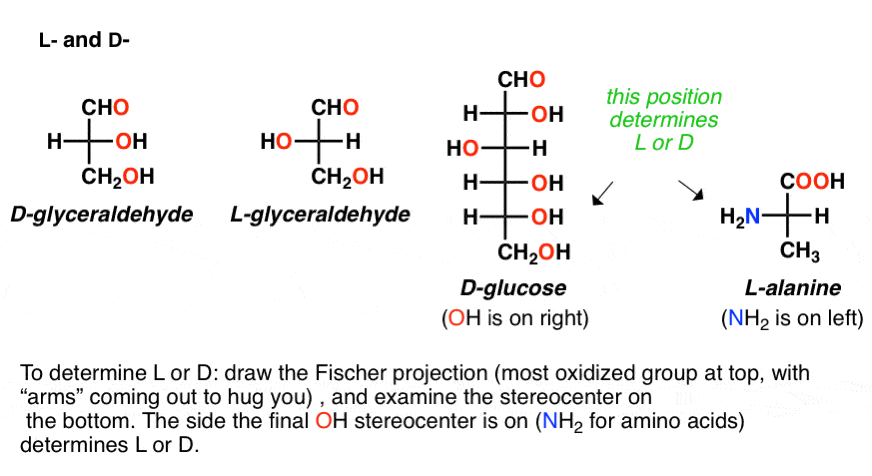
- When it’s used: for sugars and amino acids.
- What it means: It goes back to Emil Fischer, who designated the two enantiomers of glyceraldehyde (the simplest sugar) L-glyceraldehyde and D-glyceraldehyde. At a time (1890) where techniques for determining absolute structure were not available, he GUESSED(!) that structure of the leveratory (left-rotating) and dextrarotatory (right-rotating) structures of glyceraldehyde was as depicted in the Fischer projection, and gave them the prefixes L and D respectively. Thankfully, when X-ray crystallography was developed, it was found that his guess was correct. In L-sugars, the oxygen on the carbon second from the end is on the left hand side in the Fischer projection. In D-sugars, the oxygen is on the right-hand side.
- Why it’s useful: It was originally used to correlate the absolute structures of sugars to the two glyceraldehydes. It is no longer useful for this purpose, but like the appendix, it hangs around anyway. Like the appendix, it only seems to get noticed when it causes problems.
- Notes: This notation causes a lot of confusion. Just because something is “D” does not mean it rotates polarized light to the right and vice versa [that is the function of (+)- and (–)]. For example D-fructose rotates polarized light to the left (–). Furthermore, any correlation between L/D and S/R is coincidental. The 20 essential amino acids in the body are L-amino acids. They are all (S) except for cysteine, which is (R) (due to the sulfur having higher priority in the Cahn-Ingold-Prelog rules). Racemates are written as DL (for instance, DL-glucose is the racemic mixture).
5. (+) and (–)
- When it’s used: for any optically active compound
- What it means: (+) and (–) refer to the direction in which pure enantiomers of this compound rotate plane-polarized light. (+)-indicates clockwise rotation, while (–)-indicates counterclockwise rotation.
- Example: (+)-glucose, (–)-cysteine
- Why it’s useful: it depicts the direction of optical rotation.
- Notes: Racemic mixtures are referred to as (+/–), e.g. (+/–)-fructose
6. Vicinal and Geminal (vic– and gem-)
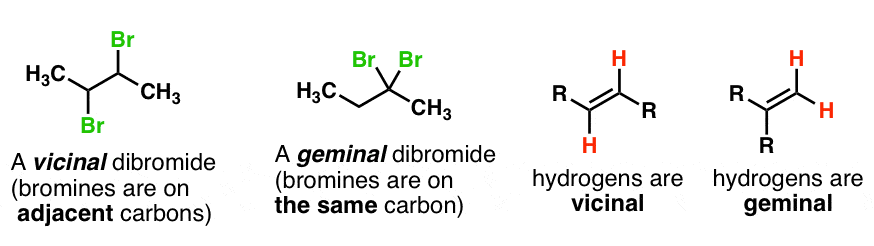
- When it’s used: often used in NMR to depict the relationships between hydrogens, also used to describe certain types of products (e.g. bromination produces vic-dibromides).
- What it means: Vicinal refers to two functional groups on adjacent carbons. Geminal refers to two functional groups on the same carbon.
- Why it’s useful: Instead of saying “the protons are on adjacent carbons” or “the protons are on the same carbons”, you can say “the protons are vicinal” or “the protons are geminal”.
- Notes: remember “gem” like “Gemini”, the constellation and astrological sign, meaning “twins”.
7. Methyl, methylene, methine
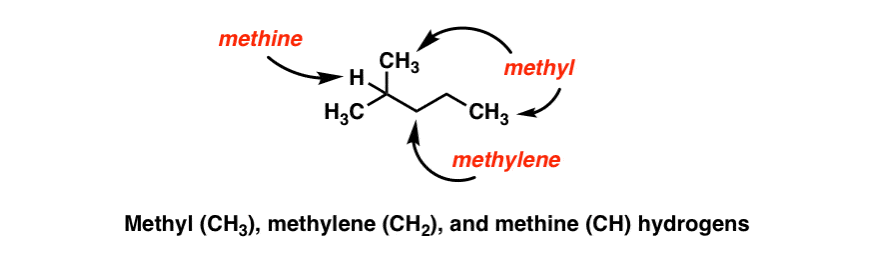
- When it’s used: most commonly in referring to protons in NMR
- What it means: methyl protons are on a primary carbon (CH3). Methylene protons are on a secondary carbon (CH2). Methine protons are on a tertiary carbon (CH).
- Why it’s useful: In the case of methine, useful shorthand for saying “proton on a tertiary carbon”.
8. Alpha and beta (α/β)
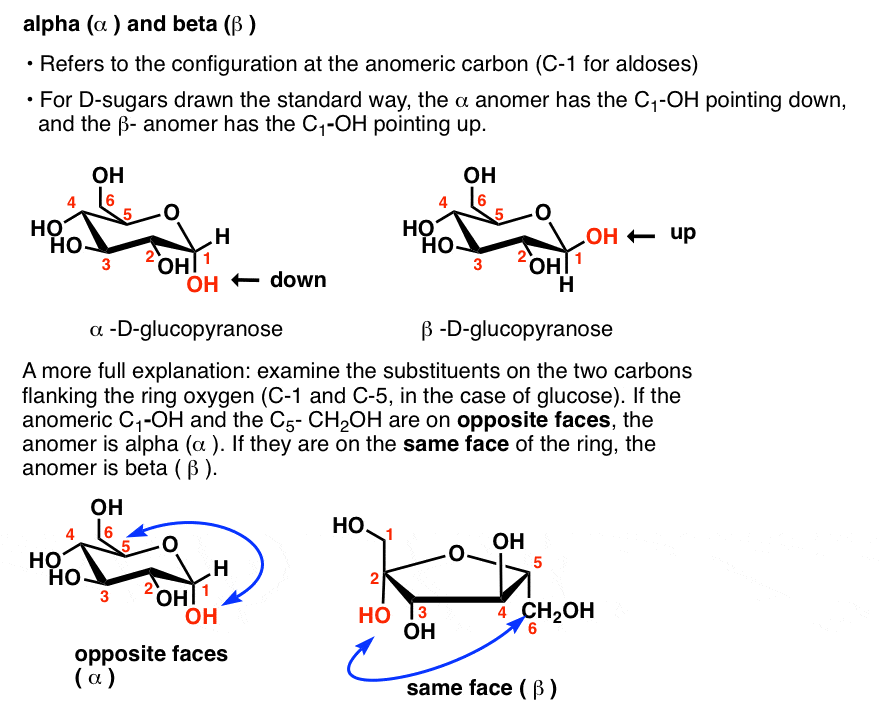
- When it’s used: Predominantly seen in naming sugars. Also used for steroids.
- What it means: When the sugar is drawn in the orientation as shown (carbons 1 through 5 follow a clockwise path), if the anomeric oxygen is UP (equatorial) it is “beta”, and if it is “down” it is alpha. [EDIT: as Bruce notes, this is incomplete and works only for D-sugars. More properly, a sugar is “alpha” if the C-1 OH and the substituent on the penultimate carbon (the CH2OH attached to C5) are on opposite sides of the ring, and “beta” if those two substituents are on the same side. See The Big Damn Post of Sugar Nomenclature for a more thorough description. ]
- Why it’s useful: Useful shorthand for describing the orientation of the anomeric oxygen which can be crucial in biochemistry. Cellulose and starch differ only in how the glucose subunits are linked together. We can digest starch (α-linked) but not cellulose (β-linked)
- Notes: The sugar has to be drawn in this specific orientation in order to apply α,β (it is a convention).
9. Erythro and threo
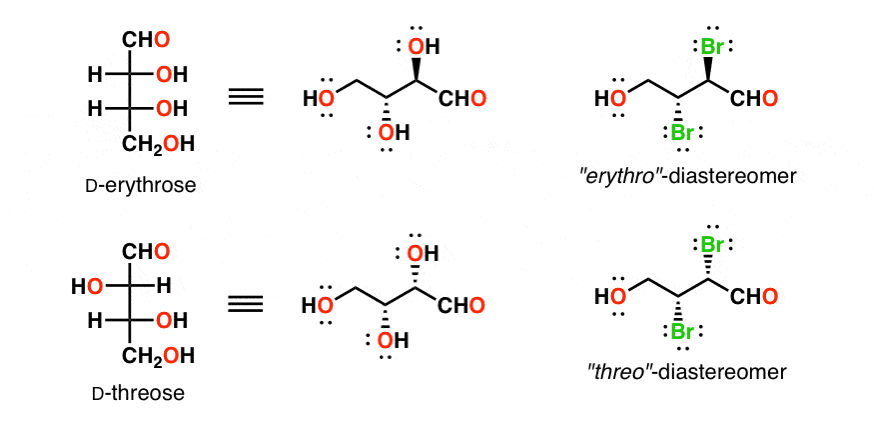
- When it’s used: Kind of old-fashioned, but indicates a diastereomeric relationship between two compounds with adjacent stereocenters.
- What it means: Erythrose and threose are the 4-carbon aldoses and they are diastereomers. In erythrose, a the oxygens are oriented on the same side in the Fischer projection. In threose, they are oriented trans. The erythro- and threo– prefixes generalize this relationship to other diastereomers.
- Why it’s useful. To be honest, if you’re not going beyond sophomore organic chemistry, it’s probably not all that useful.
Questions, comments, anything missing – as always, I want to hear about it.
Find Master Organic Chemistry first when you search on Google:
Please suggest me a book or a website to learn nomenclature of polycyclic compound with substituent
Bite the bullet and read the IUPAC blue book?
Very helpful resource
A question:
I am helping a non-native English speaker with a “manure” problem.
I think this is error but cannot find the answer google-monkeying around:
the 2,936-2,956 cm-1 peak is the C-H stretching vibration of aliphatic methyl, methylene, and methylene
==
They correspond to “H-C-, H-C=, H-C≡”; but i don’t know how to express the “H-C≡” in English.
Hi Steve – A tertiary carbon bonded to hydrogen is called, “methine”
Hi…
Could you please explain the meaning of using a ‘dash’ over the repeated term as in, p,p’-dihydroxybenzophenone,
That p,p’ poses me a problem…
Benzophenone has two phenyl groups, which we can abbreviate by Ph. To differentiate them, one can call one of them Ph and the other Ph prime (abbreviated Ph’). For dihydroxybenzophenone where there is an OH group para on the Ph group and also an OH group para on the Ph’ (Ph prime) we therefore say, “p,p’-dihydroxybenzophenone)
It’s superfentabulous resource for ORGANIC CHEMISTRY.
JAMES, you and this website are amazing.
It very fun and amazing to read organic chemistry in this website.
THANK YOU
Awesome site. Thank you! But your rule #8 (alpha vs. beta) only applies to D-sugars. It is opposite for L-sugars.
Thanks Bruce – fixed!
In section 4 on L- and D- enantiomers it seems that gluteraldehyde has been used instead of glucose.
? Gluteraldehyde is a completely different molecule – a dialdehyde lacking any hydroxy groups…
Hi, I just wanted to agree with the above praise.
Also, don’t discount the value of number 9 (erythro- and threo-) because that’s what brought me here. I came upon
l-erythro-3,5-diaminohexanoate in a paper and needed to know what it is. Sure, I can google it but I also wanted to understand it. Thanks for the help!
Your articles are life-savers for organic chemistry students like me. Thank you!
Glad to hear it Cassandra. Thank you.
This is a fantastic site! I was trying to find our what N meant in the compound N-methyl D-aspartate. It has been 50 years since I took organic chem and could not remember. I did remember what the D stood for. Thanks
Elaine – thanks for letting me know! Glad the site can be of service – James
Could you help me by explaining the the use of alpha in the case of morphine’s IUPAC?
(5α,6α)-17-Methyl-7,8-didehydro-4,5-epoxymorphinan-3,6-diol
I’m understanding that the numbers within are identifying the location in the structure in which these can be found but I’m still unsure about the part in parenthesis.
Hi
(5α,6α)-17-Methyl-7,8-didehydro-4,5-epoxymorphinan-3,6-diol
I’m understanding that the numbers within are identifying the location in the structure in which these can be found but I’m still unsure about the part in parenthesis.
Alpha and beta are relatively old terms for denoting the orientation of atoms with respect to the plane of the ring (stereochemistry). It’s common in steroids and sugars (e.g. alpha-glycoside or beta-glycoside)
http://science.uvu.edu/ochem/index.php/alphabetical/a-b/alpha-anomer/
Alpha means the substituents are on the “bottom” plane of the ring, but at this moment I can’t find out how which plane of the ring is defined as the “top” and “bottom” .
If the stereochemistry of the alcohol on 6 was flipped, it would be labelled (5a, 6B)-17-Methyl…..
Hope this helps – James
This is very helpful. By the way, when there’s an “A” beside a number in the chemical name, what does it intepret?
For example, mono-6A-ammonium-6A-deoxy-CD chloride.
Sounds like you’re describing a tetracycline or similar cyclic compound. In complex ring systems there are weird IUPAC nomenclature conventions that I confess I haven’t tried to understand very much. Sorry, I don’t know.
I often see the “prime” symbol after a letter or number in the notation describing an organic molecule. For example, 2′-F, 2′-C-methyluridine-5′-monophosphate . I’m guessing the F means floro, but I am clueless about the primes. Help!
Hello!, love your site, btw.
I’m trying to figure out what the ” R* ” reference is in the following synonym for Endrin aldehyde:
1,2,4-Methenocyclopenta(cd)pentalene-5-carboxaldehyde, 2,2a,3,3,4,7-hexachlorodecahydro-, (1alpha,2beta,2abeta,4beta,4abeta,5beta,6abeta,6bbeta,7R*)-;
It’s some bit of more obscure meta-info , but I can’t find in referenced anywhere…can you help??
thanks!
The presence of identical unsubstituted radicals is indicated by the appropriate multiplying prefix di-, tri-, tetra-, penta-, hexa-, hepta-, octa-, nona-, deca-, undeca, etc.
The presence of identical radicals each substituted in the same way may be indicated by the appropriate multiplying prefix bis-, tris-, tetrakis-, pentakis-, etc. The complete expression denoting such a side chain may be enclosed in parentheses or the carbon atoms in side chains may be indicated by primed numbers.
Ref: http://www.acdlabs.com/iupac/nomenclature/79/r79_36.htm
Dear James,
At the IUPAC system, the correct nomenclature of 2-butanol is butan-2-ol. The number of function’s position have to precede it.
Thanks
The purpose of nomenclature is to provide a unique, non-ambiguous way of translating a name to a structure. 2-butanol satisfies this criterion. It is also easier to say. The nomenclature system exists to serve us, not the other way around.
Hi, you mentioned that alpha and beta are used in naming sugars and that they are also used for steroids. What about terpenes? Can you tell me what alpha-myrcene is indicating as opposed to beta-myrcene? Thank
What’s the “O” mean in 4-O-methylhonokiol?
It’s saying that the oxygen has a methyl group attached. Kind of a weird way of naming it, you don’t see this very often. It’s more often seen with amines (e.g. N-methylformamide)
Another nice piece of clarification!
I would suggest that you add another notation used in organic chemistry conversations and contrasted with your number 8. That would be the use of Greek characters to refer to carbons counted from a functional group. For example, α,β-diketones, β-amino acids, β-keto esters, etc.
Great suggestion. Thanks!
Great list! You know what would be helpful for readers like me is you have an ability to export these posts into pdf files to print out, or at least have some ability to easily print out these posts. Maybe there is one present on this blog, but I couldn’t find it. I know there must be a plugin for wordpress that allows this.
You can try clicking on the post and then Print – you should get an option to Print as PDF, and there you go.
This may be system dependent, however. It works OK on my home PC and office one, but not on the one in the library. Perhaps you need something like ghostscript or similar installed?
I think many times chemists forget that you don’t know little terms and never think to explain them. This leaves students that are probably way too attention-detailed for their own good to have trip up a lot on things that could have easily been explained but never were. This page has solved multiple problems of mine that I either never understood or had to search a lot to find. Should be at the first of every nomenclature chapter of every ochem book! :)
Thanks!
Thanks! That’s the goal… to try and make summaries of things that haven’t been summarized before.
wow – this is a fantastic resource. what astonishes me is that i’ve not seen anything like it until now (not in a textbook or website).
thank you!
sue