Alkanes and Nomenclature
Primary, Secondary, Tertiary, Quaternary In Organic Chemistry
Last updated: May 28th, 2026 |
How To Recognize Primary, Secondary, Tertiary (and sometimes Quaternary) Hydrocarbons, Carbocations, Alkyl Halides, Alcohols, Amines, and Amides.
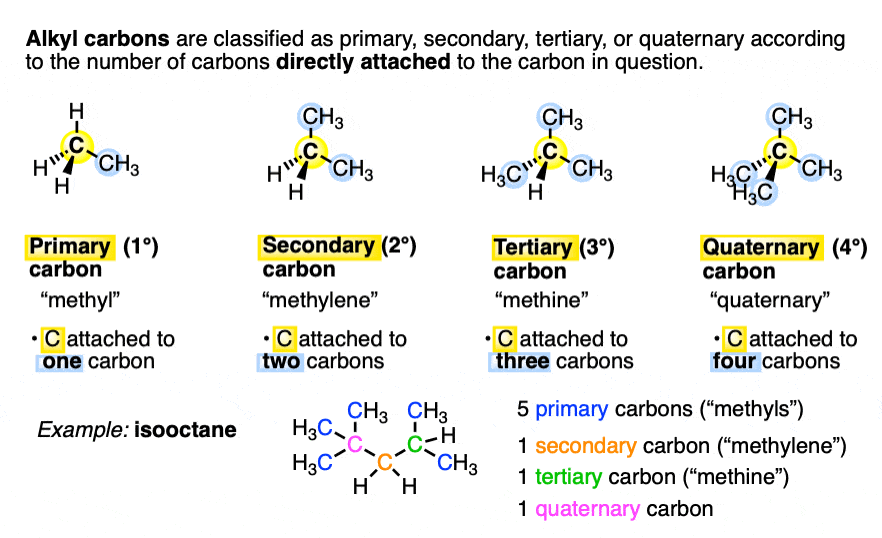
- Primary (1°), secondary (2°), tertiary (3°) and quaternary (4°) alkyl carbons are defined according to the number of carbons directly attached to that carbon.
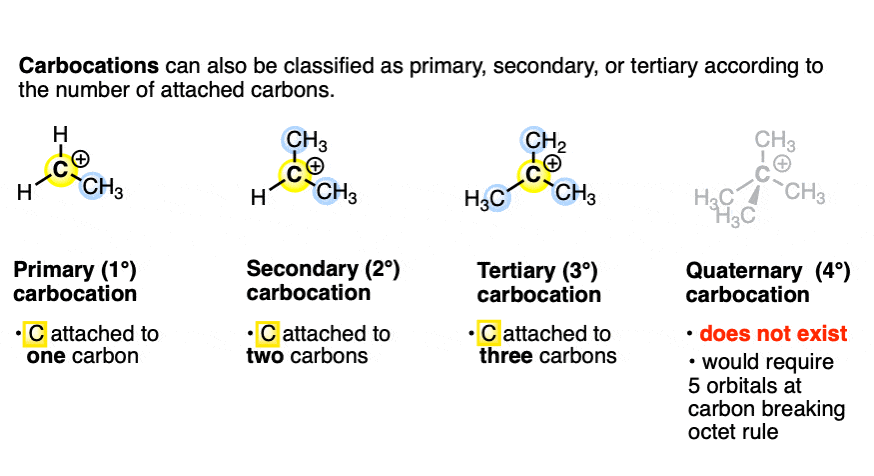
- Similar nomenclature can be used for carbocations. Primary (1°), secondary (2°), and tertiary (3°) carbocations are defined according to the number of carbons directly attached to the carbon bearing the positive charge.
- Primary (1°), secondary (2°), and tertiary (3°) alcohols are defined according to the number of carbons directly attached to the carbon bearing the hydroxyl group.
- Primary (1°), secondary (2°), and tertiary (3°) alkyl halides are defined similarly to alcohols.
- Amines and amides are defined according to the number of carbons directly attached to the nitrogen atom.
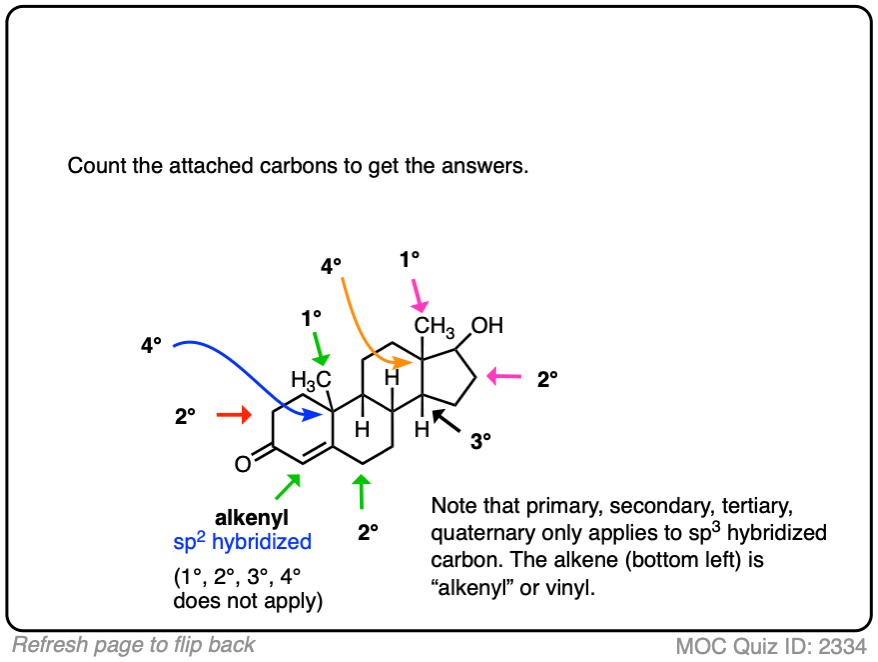
- This classification system only applies to sp3 hybridized carbons (alkyl).
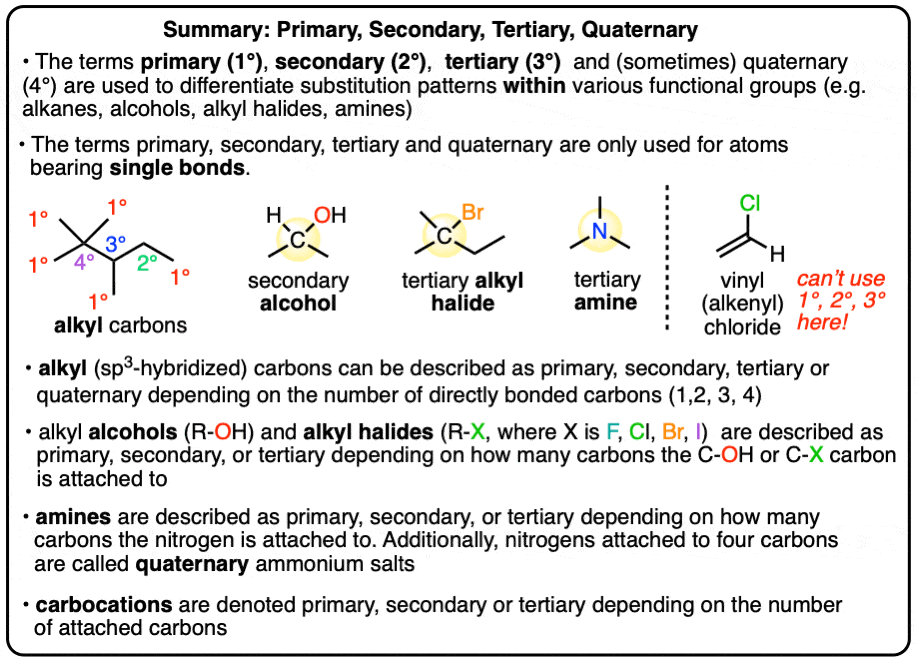
Table of Contents
- Primary, Secondary, Tertiary and Quaternary Alkyl Hydrocarbons
- Primary, Secondary, and Tertiary Carbocations
- Primary, Secondary and Tertiary Alcohols
- Primary, Secondary, and Tertiary Alkyl Halides
- The Special Case of Methane and Methyl
- Primary, Secondary, and Tertiary Amines (and Quaternary Ammonium Salts)
- Primary, Secondary and Tertiary Amides
- Notes
- Quiz Yourself!
- (Advanced) References and Further Reading
1. Primary, Secondary, Tertiary, and Quaternary Alkyl Hydrocarbons
There are four possible bonding patterns for alkyl carbons in hydrocarbons.
- Primary carbons (1°), are carbons attached to one other carbon and three hydrogens. Also known as a methyl (CH3) carbon or “methyl group”.
- Secondary carbons (2°) are attached to two other carbons and two hydrogens. Also known as methylene (CH2) carbons.
- Tertiary carbons (3°) are attached to three other carbons and one hydrogen. Also known as methine (R3CH) carbons.
- Finally, quaternary carbons (4°) are attached to four other carbons.
You can’t go higher than that! To have five substituents, you’d need 10 electrons around carbon, a clear violation of the octet rule. When people do write 5 covalent bonds around carbon, it’s a mistake. [Note 1]
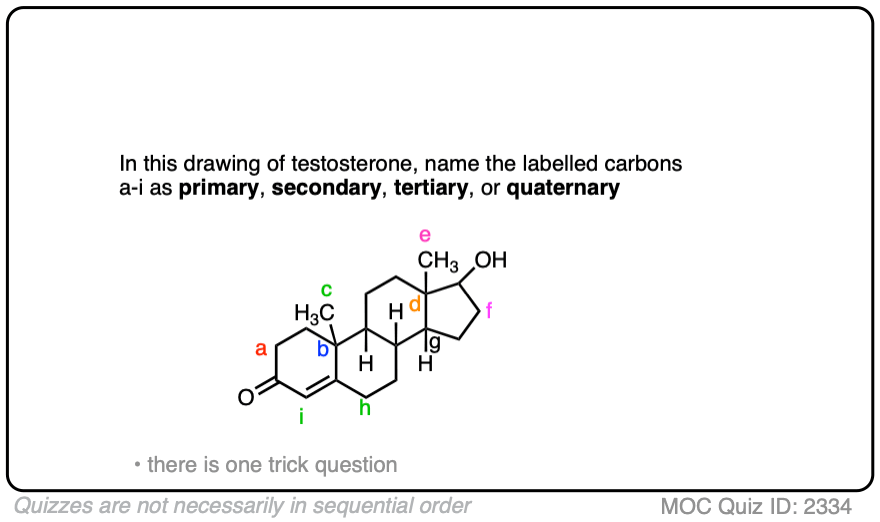
Ready to flex your muscles in a test? See if you can properly identify all the labelled carbons on testosterone.
 Click to Flip
2. Primary, Secondary, and Tertiary Carbocations
Carbocations can also be classified as primary, secondary, or tertiary according to the number of carbons directly attached to the positively charged carbon.
Quaternary carbocations don’t exist. The problem is that the extra p-orbital on carbon would bring the number of orbitals on carbon to 5, violating the octet rule.
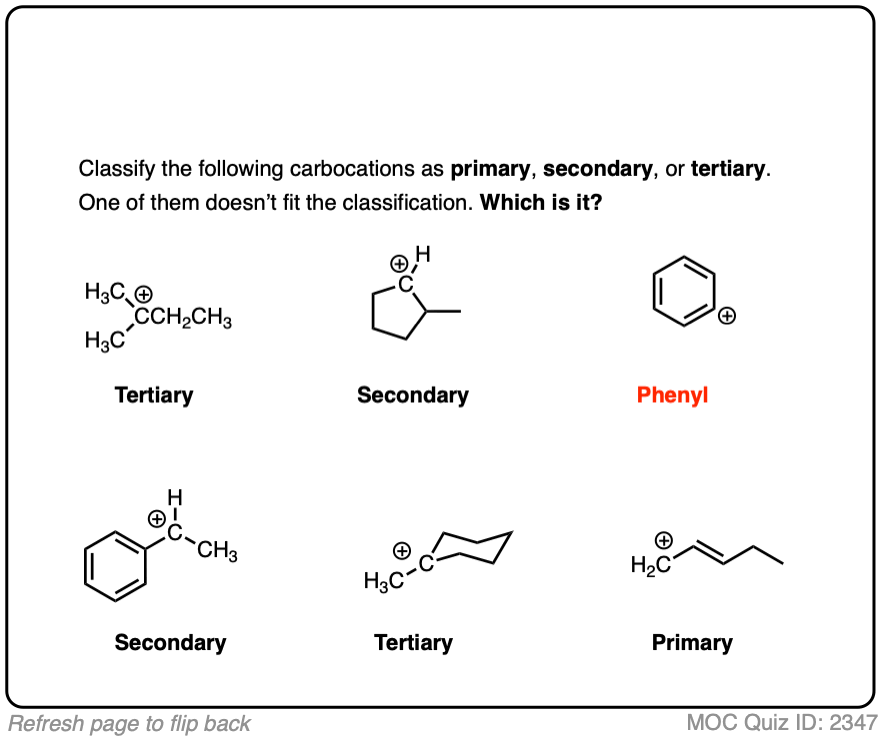
See if you can properly classify the following carbocations as primary, secondary, or tertiary.
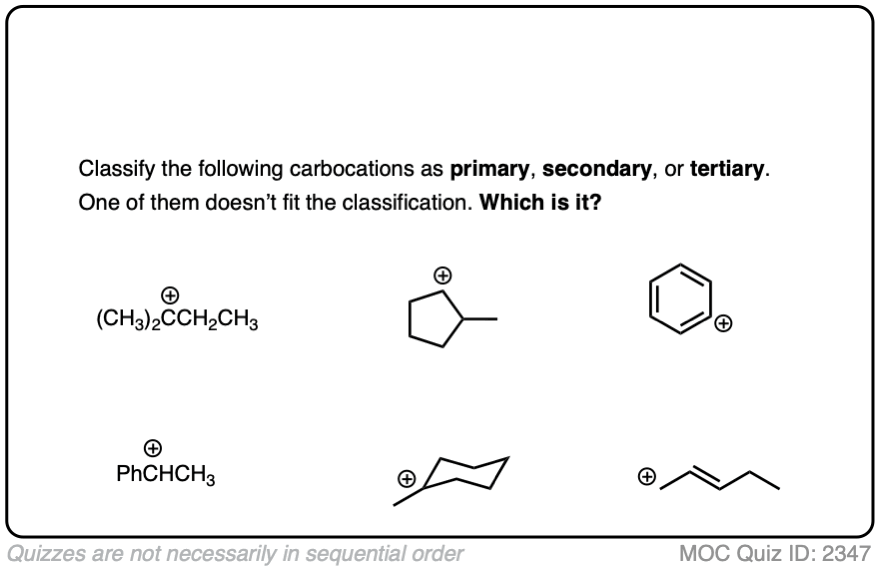 Click to Flip
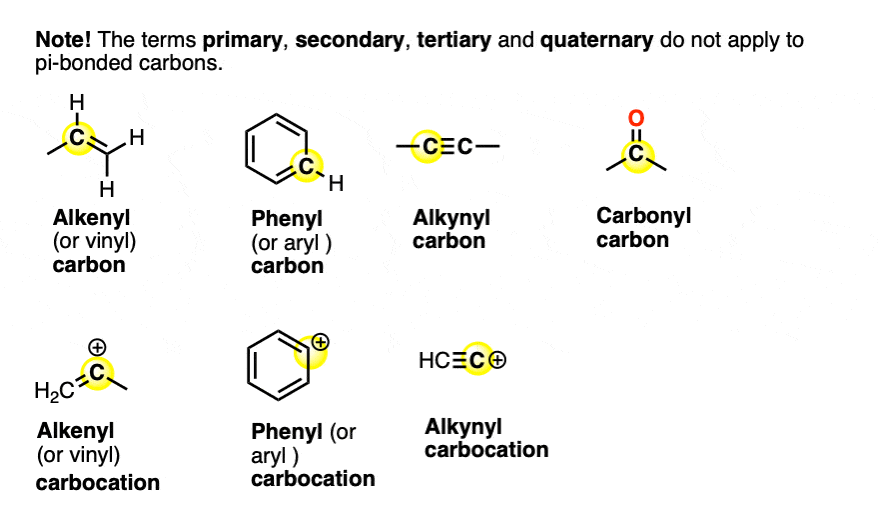
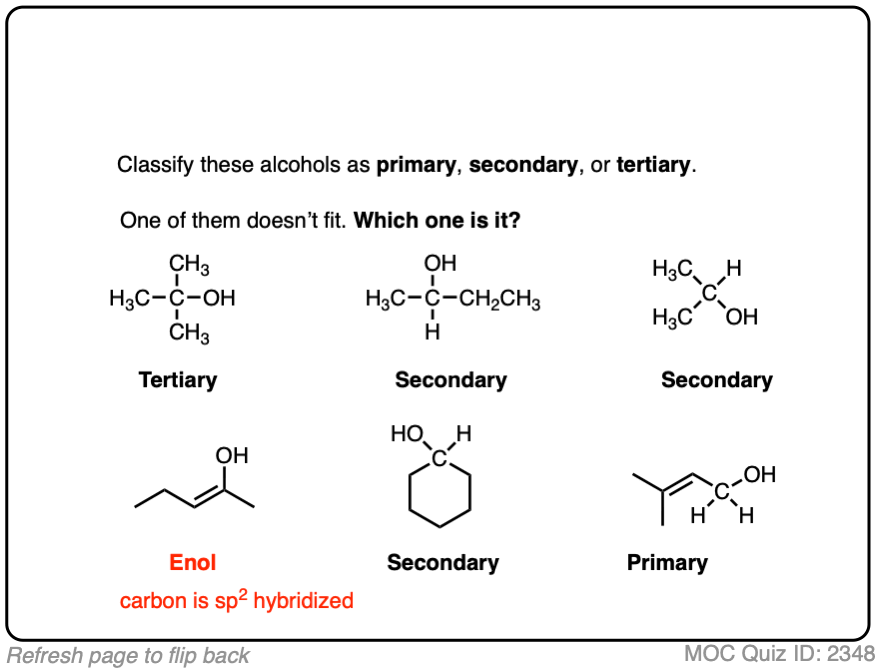
It’s important to note that the terms primary, secondary, tertiary and quaternary only apply for alkyl carbons and carbocations. When the carbon participates in pi-bonding, different names are applied.
3. Primary, Secondary, and Tertiary Alcohols
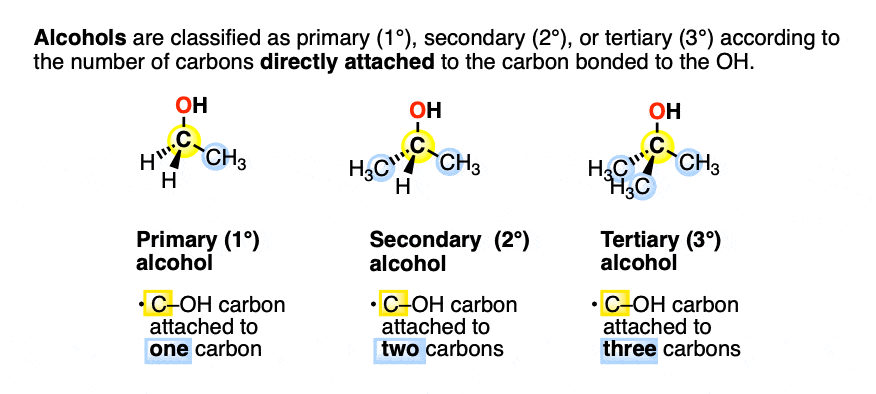
Primary, secondary, and tertiary alcohols are named according to the number of carbons directly attached to the C-OH carbon. (This carbon is sometimes known as the carbinol carbon).
There is no such thing as a quaternary alcohol because that would require having 5 bonds to carbon.
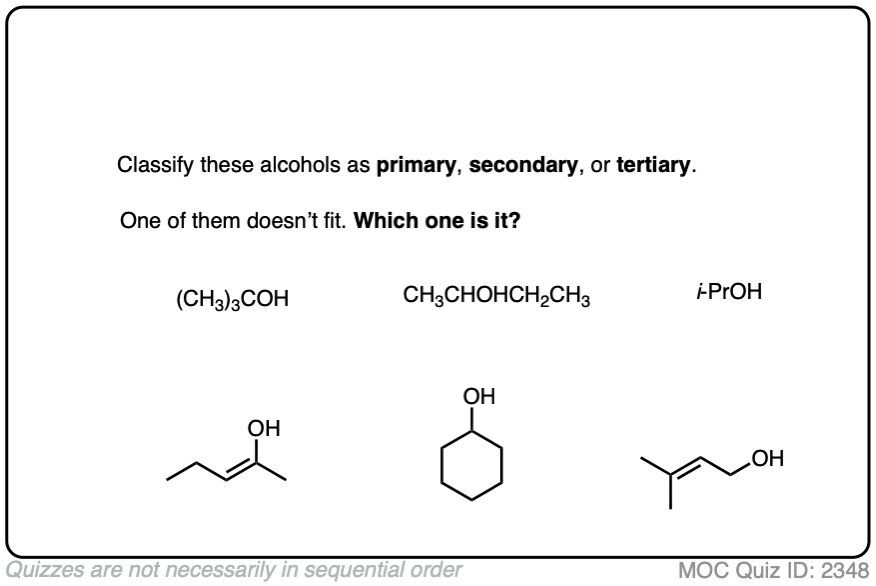
See if you can classify the following alcohols as primary, secondary, or tertiary.
 Click to Flip
4. Primary, Secondary, and Tertiary Alkyl Halides
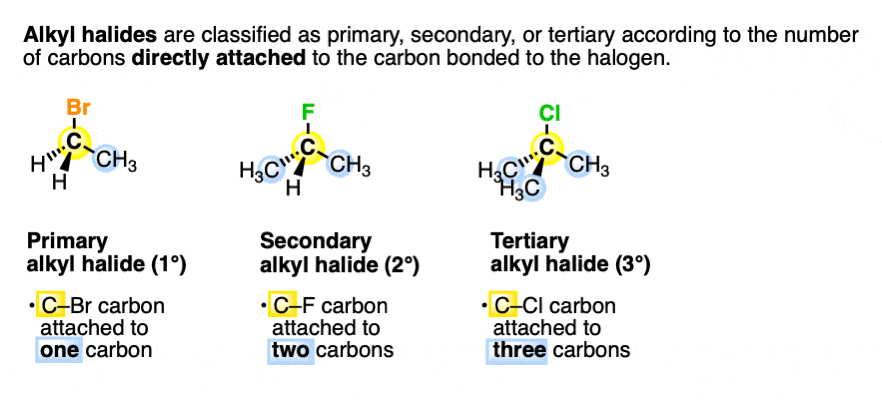
Alkyl halides have an sp3 hybridized carbon directly attached to a halogen.
Like alcohols, they are named according to the number of carbons directly attached to the carbon containing the halogen.
See if you can properly classify the following alkyl halides as primary, secondary, or tertiary.
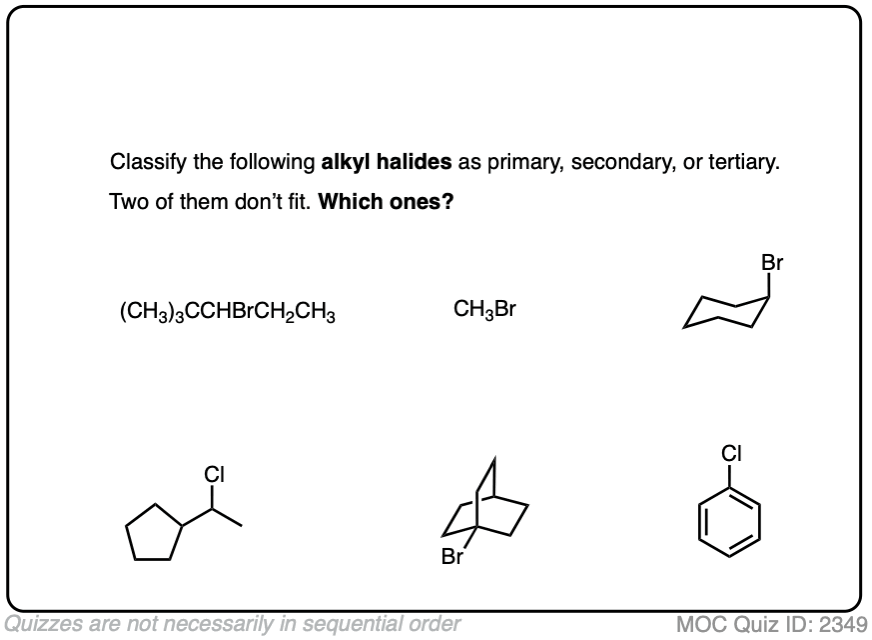 Click to Flip
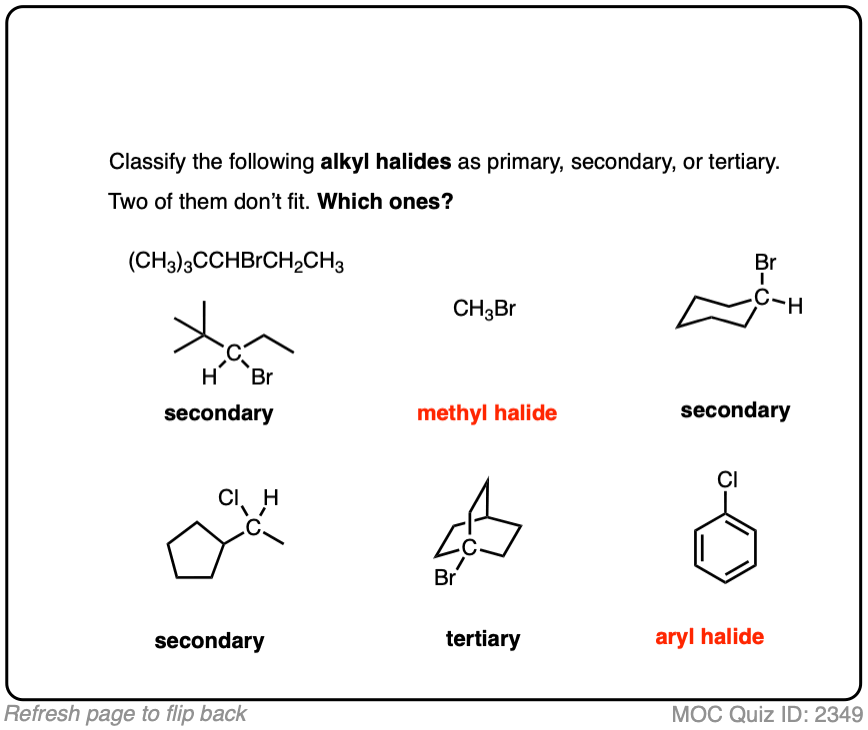
Just to give you fair warning, being able to classify alkyl halides as primary, secondary or tertiary is a key skill. When you encounter nucleophilic substitution and elimination reactions, you’ll see that the reactivity of alkyl halides is significantly affected by their substitution pattern.
5. A Special Case: Methane And Methyl Groups
Up to this point we’ve left out the special case of methane, the only hydrocarbon which lacks any carbon-carbon bonds.
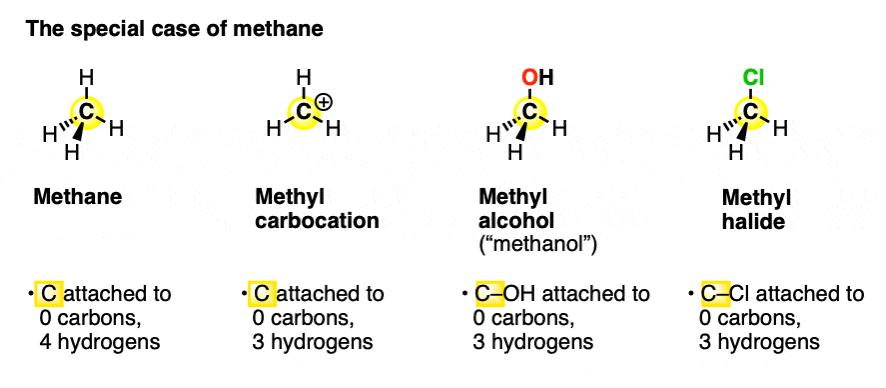
Methane, the methyl carbocation, methanol, and methyl halides are distinct from the “primary, secondary, tertiary” naming convention.
6. Primary, Secondary, and Tertiary Amines (and Quaternary Ammonium Salts)
Next, we come to amines, which are named a little bit differently than the previous examples. [Note 2]
Amines are named according to the number of carbons attached to the nitrogen.
Primary, secondary, and tertiary amines are nitrogens bound to one, two and three carbons, respectively.
It is possible for the nitrogen to be bound to a fourth carbon. This species is known as an alkylammonium salt. It is not technically an amine since it lacks a lone pair on nitrogen and therefore cannot act as a Lewis base.
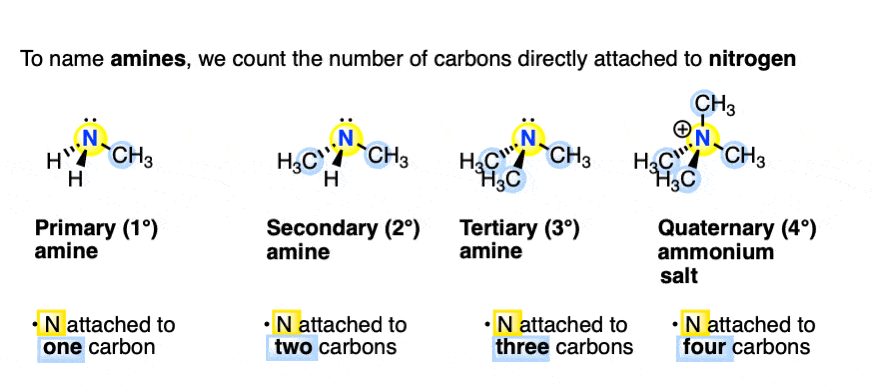
Remember that the positive formal charge on nitrogen doesn’t imply that there is an empty p orbital there! Always assume a full octet on positively charged nitrogen and oxygen.
See if you can tell the difference between these primary, secondary and tertiary amines.
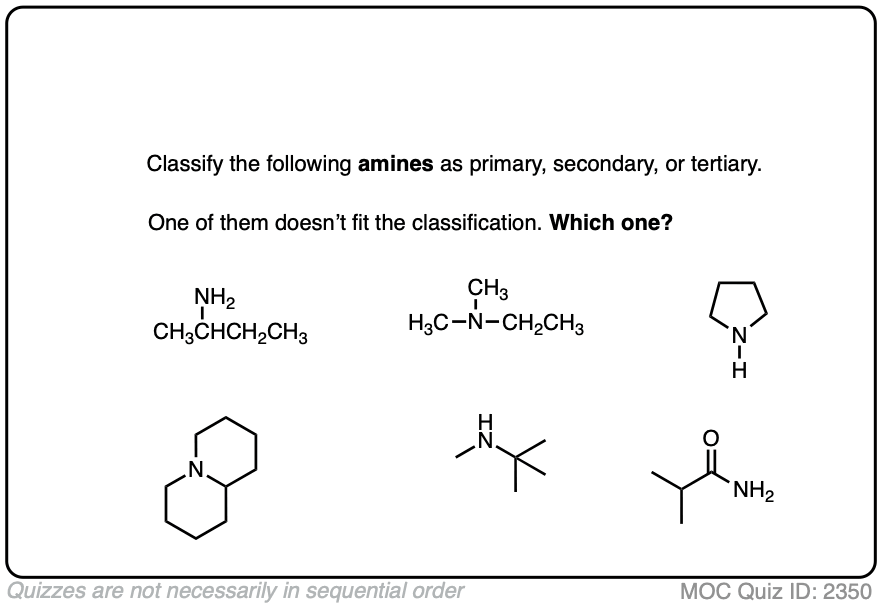 Click to Flip
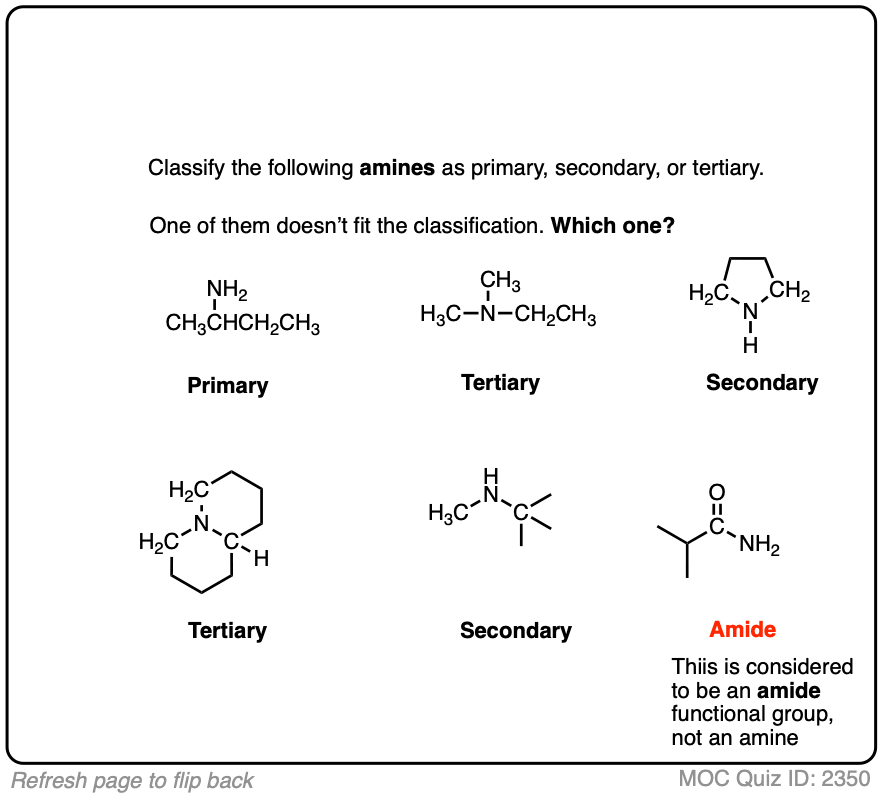
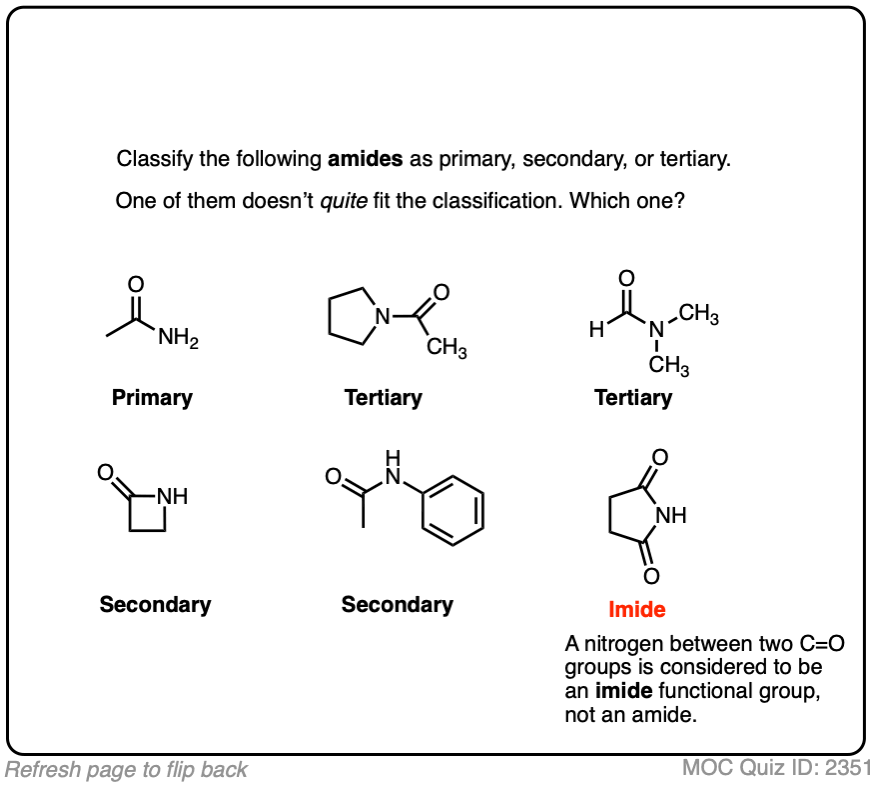
7. Primary, Secondary, and Tertiary Amides
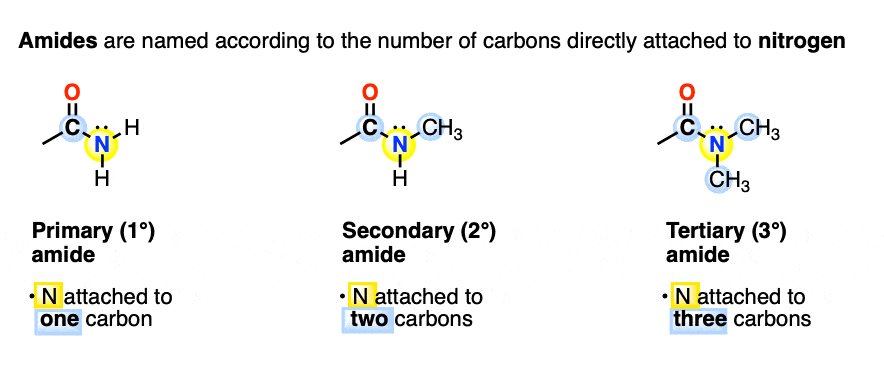
The naming of amides is similar to that of amines.
A primary amide has the nitrogen bonded to one carbon – the carbonyl carbon.
Secondary and tertiary amides have the nitrogen bonded to two and three carbons respectively. (There is an amide counterpart to a quaternary ammonium salt, but it goes by a different name and you might go through introductory organic chemistry without ever seeing an example. – Note 3)
Quiz yourself on naming amides, here.
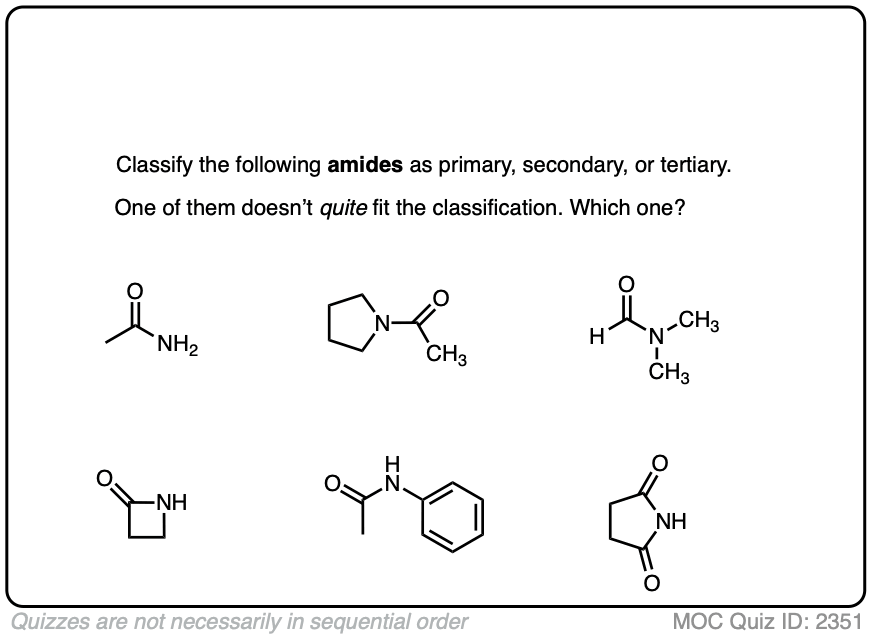 Click to Flip
Notes
Note 1. These are often called Texas carbons because it resembles a star and because, y’know, “everything is bigger in Texas”.
Note 2. Note that methylamine is a primary amine, but methyl alcohol is not a primary alcohol.
Note 3. These are called acylammonium salts.

Quiz Yourself!
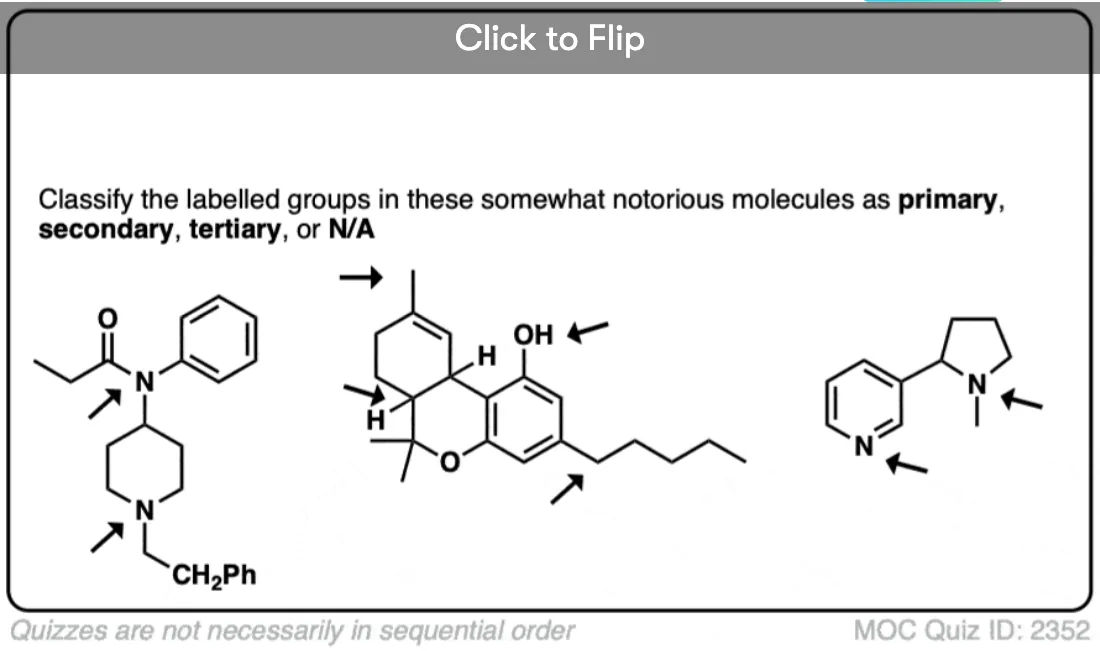
Become a MOC member to see the clickable quiz with answers on the back.
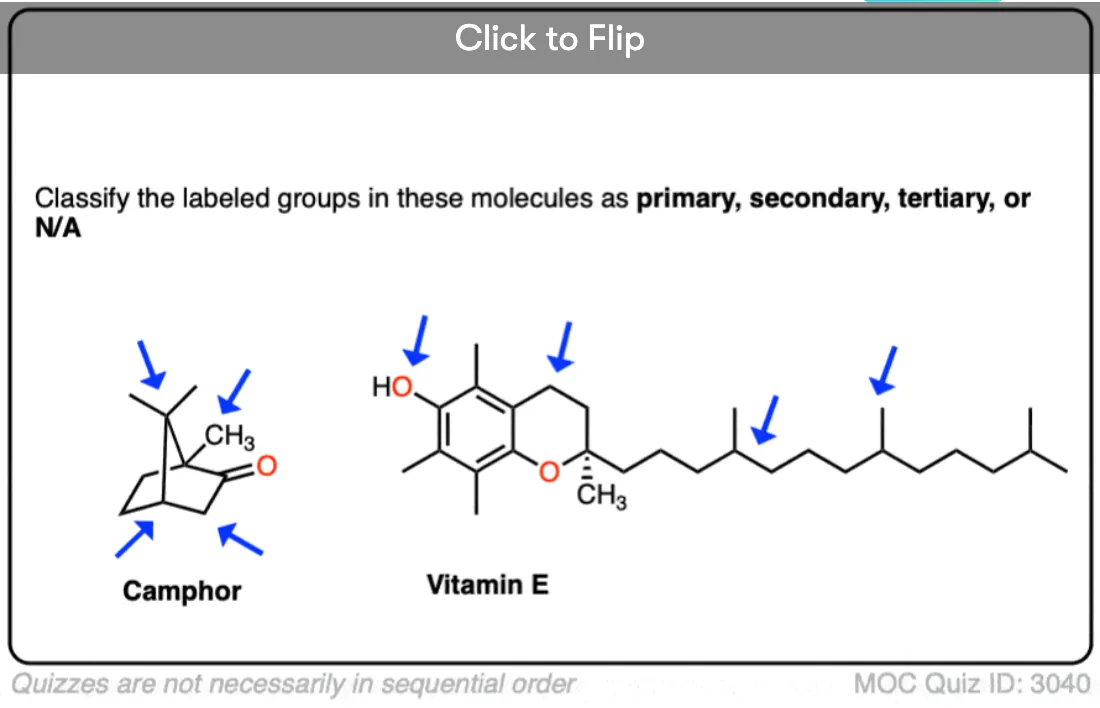
Become a MOC member to see the clickable quiz with answers on the back.
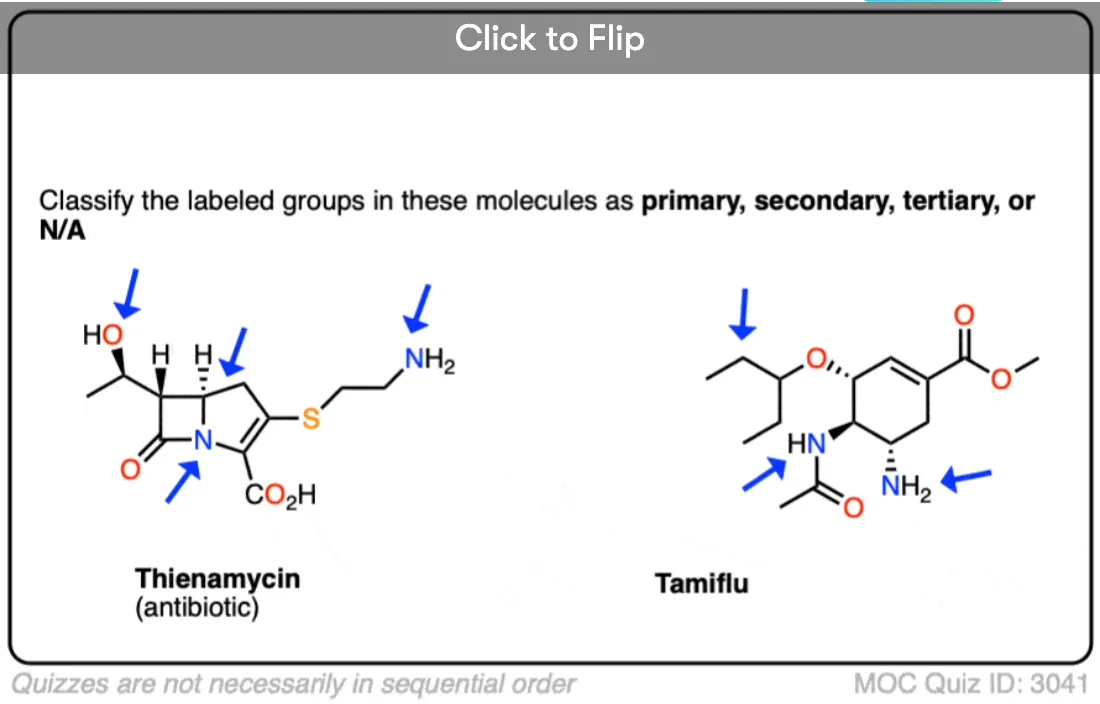
Become a MOC member to see the clickable quiz with answers on the back.
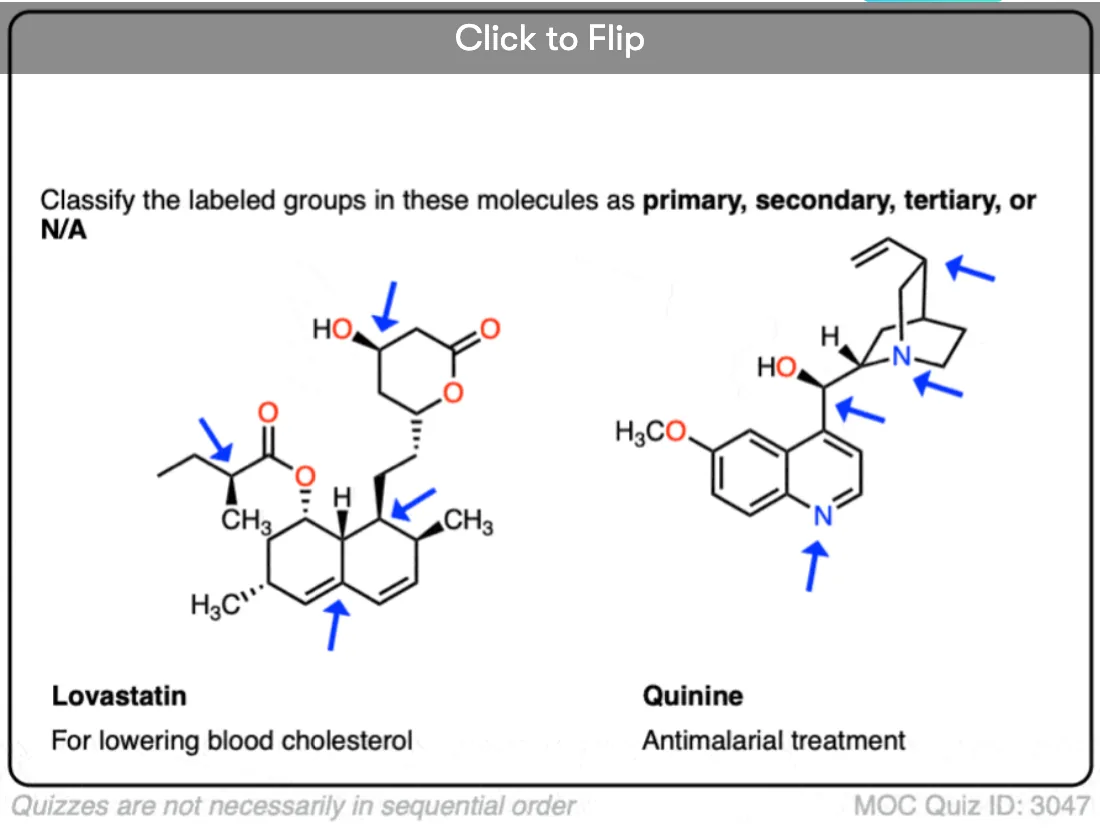
Become a MOC member to see the clickable quiz with answers on the back.
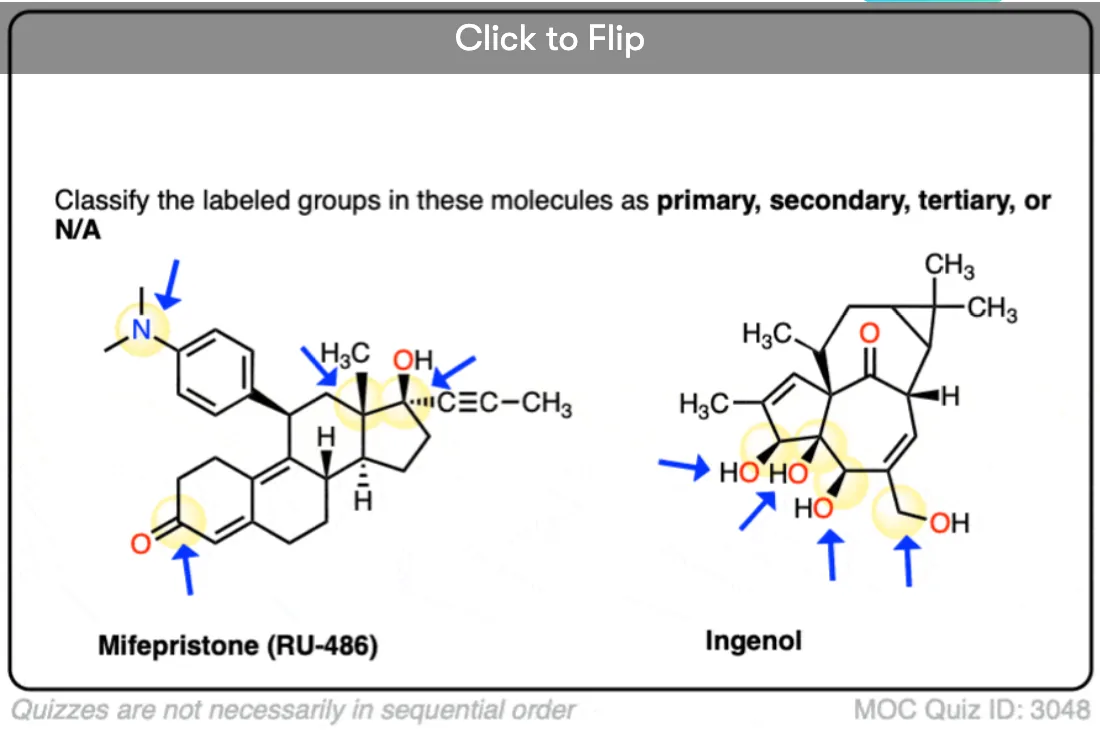
Become a MOC member to see the clickable quiz with answers on the back.
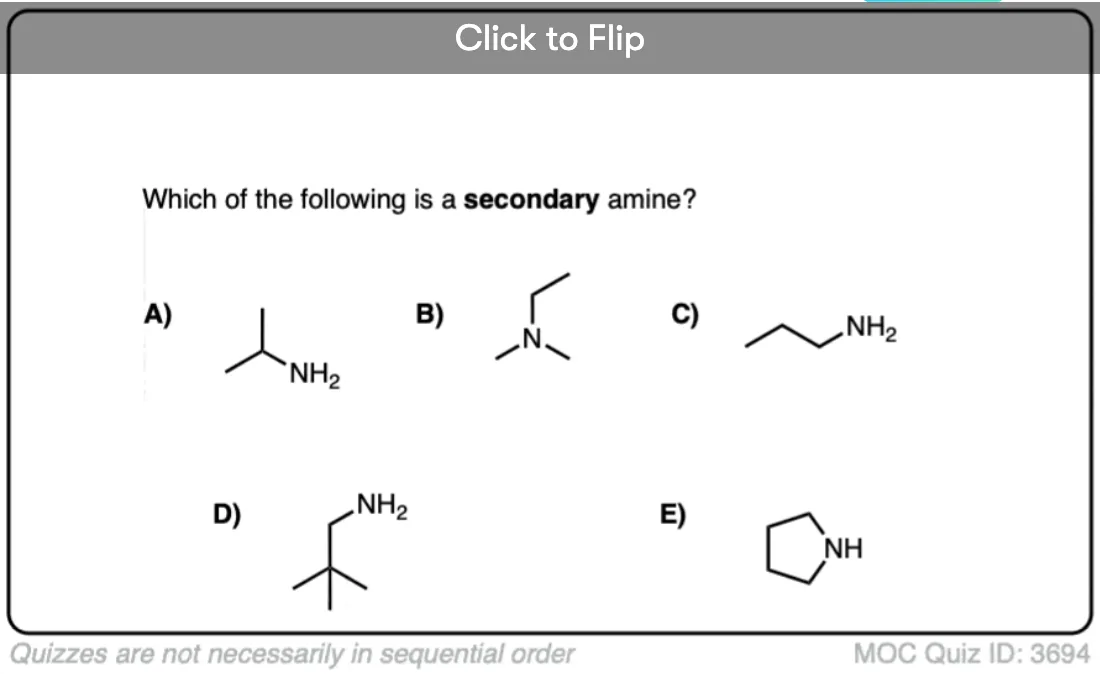
Become a MOC member to see the clickable quiz with answers on the back.
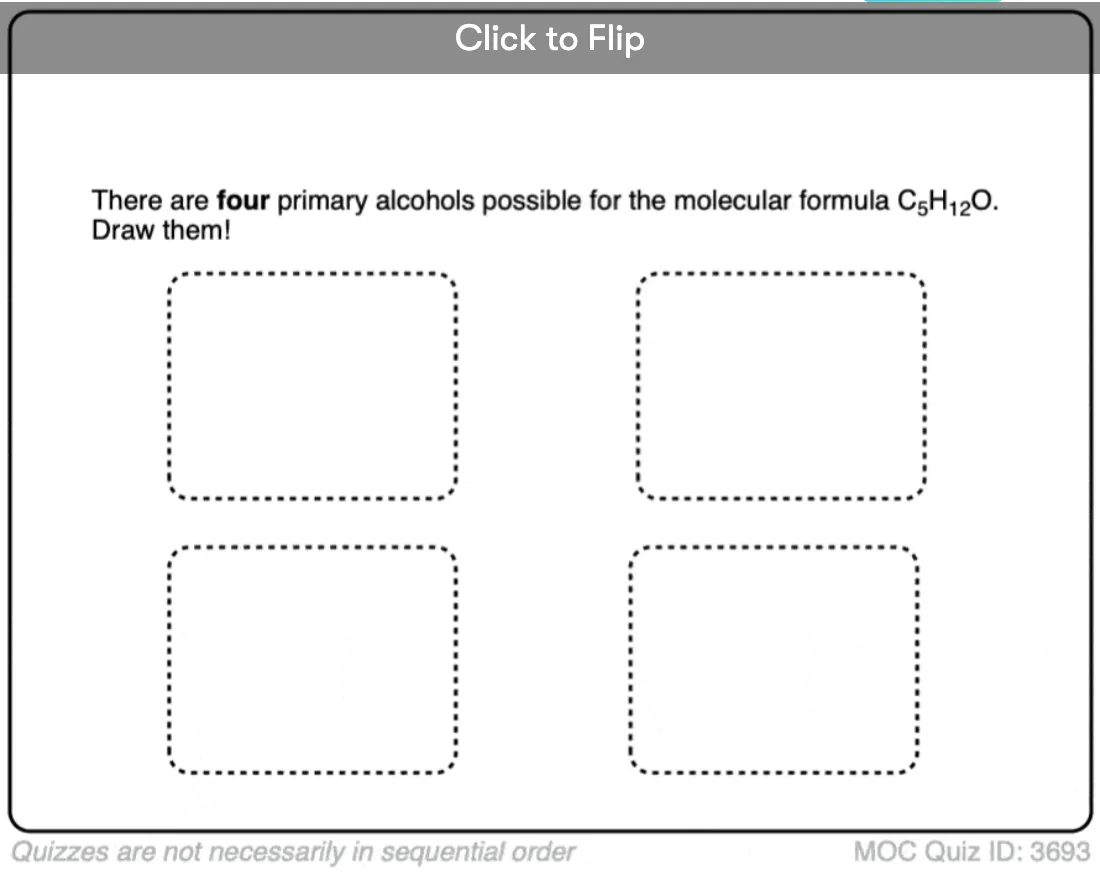
Become a MOC member to see the clickable quiz with answers on the back.
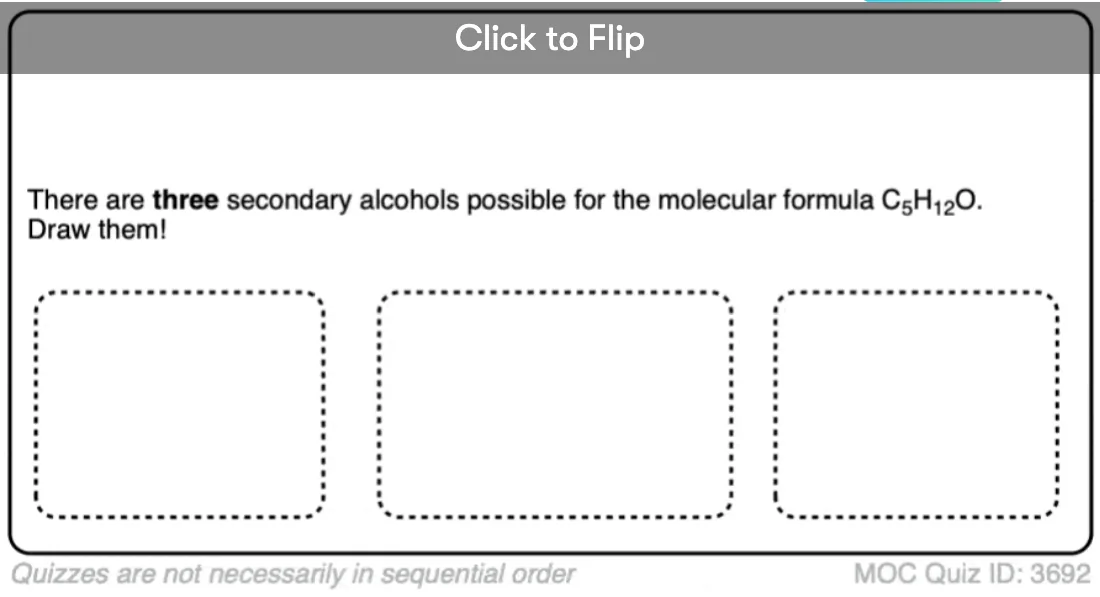
Become a MOC member to see the clickable quiz with answers on the back.
(Advanced) References and Further Reading
Some IUPAC definitions on nomenclature:
- Alcohols. From the IUPAC Gold Book.
DOI: 10.1351/goldbook.A00204 - Amines. From the IUPAC Gold Book.
DOI: 10.1351/goldbook.A00274 - Amides. From the IUPAC Gold Book.
DOI: 10.1351/goldbook.A00266
Note that IUPAC’s definition of primary, secondary, and tertiary amides is not the definition of primary, secondary, and tertiary amides that is in colloquial use.
I would not say that carbon is pentavalent in the molecular ion CH5+. There 1 carbon and 5 protons are bonded by 8 electrons, not 10. So, carbonis certainly pentacoordinated, but not hypervalent.
Is a tri-alkylated alpha to carbonyl is considered tertiary or quaternary?
For example, is Baeyer Villiger oxidation, is the rate of migration
H > 3 > 2 > 1 > Me
or
H > 4 > 3 > 2 > 1
It would be considered tertiary. So your first listing is correct.
For more, see Note #3 in this post:
https://www.masterorganicchemistry.com/2018/10/08/nitration-baeyer-villiger/#notes
why can tertiary amines cross the blood-brain barrier but not quaternary amines?
Cyclohexanol is a secondary alcohol. Is the hydroxyl carbon properly referred to as secondary (two carbons attached) or tertiary (one hydrogen attached)?
Secondary alcohol.
Thank you !!!
What type of carbon is methane?(in the case of primary, secondary, tertiary or quaternary)
Or it called something else??
Can you help me plz!
It is unique and belongs in its own category, like ammonia (NH3) for amines and methanol (CH3OH) for alcohols. The terms primary, secondary, tertiary do not apply.
What if double bond? Is it still consider to be a primary (If it only one carbon bonded)?
Hi Josh – no, primary, secondary, tertiary is not the appropriate nomenclature with double bonds. We’ll often classify them by treating the C-C double bond as a unit and then counting how many carbons are bound to it. We can then have monosubstituted, disubstituted, trisubstituted and tetrasubstituted double bonds. That’s not quite enough, because there are actually 3 ways to have disubstituted double bonds!
These we refer to roughly as “cis”, “trans’ and 1,1-disubstituted.
See this post. https://www.masterorganicchemistry.com/2020/04/30/alkene-stability/
This helped, thanks 🙏🤗
In the case of imidazole is it possible to talk about primary, secondary, tertiary carbons or those names are only used for alkyls?
Only for alkyls.
What is the importance of quarternary carbon when naming molecules?
how many 2-degree carbon atoms are there in acetone, i mean is carbon atom bonded to oxygen considered as 2- degree or not?
I have never seen primary, secondary, tertiary, and quaternary is defined for carbons other than alkyl. Reference:
https://www.degruyter.com/view/j/pac.1995.67.issue-8-9/pac199567081307/pac199567081307.xml
Why doesn’t quaternary radical exist?
Think about the maximum number of substituents that carbon can have.
To be honest, you are the hero of organic chemistry .. thanks a lot !!!!!!!!!!
OK thanks hajar
why does amines doesn’t have the nomenclature as al others ? i mean in all other the functional grp is attached to the carbon is counted and hence primary or secondary name is given but in amines its not that way why?
Amines follow their own rules, both in nomenclature and in the flask…
LIFE CHANGING INFORMATION
Thank you for making this WAAAAAY easier then my teacher did! I really appreciate it.
OK – thanks for stopping by Mar, glad you find it useful!
what product would you expect from mono-bromination of p-methylbenzoic acid? somebody chew it up please
Go to this post. “Strongest donor wins”. https://www.masterorganicchemistry.com/2018/03/19/eas-disubstituted-benzenes/
So, Hello and can you describe the same things for hydrogen. Like 1° 2° 3°
Hydrogen. If Yes plz let me know.Thanx.
Was searching answer for my chemistry homework…..didnt got on book….remebered google has answer to each question….came here….understood everything in matter of seconds…blessed you with all my heart a good life…….THANK YOU James…??????
Why is the quaternary carbon the least reactive?
The least reactive in what sense?
How is the degree changed if there is a double bond involved?
Primary, secondary, tertiary is only defined for alkyl groups.
Why quarternary hydrogen doesnt exist ?
That’s an exercise for you to ponder.
Hello James,
Is there a technical term to call a carbon with one hydroxyl group attached? Can we call them “hydroxyl carbon” or “hydroxylic carbon”?
Thanks,
OJ
“Carbinol” is the preferred nomenclature
Can secondary carbon be attached to two carbons with one single bond, and one double bond?
Here is the problem which is on:
http://ir.kmu.edu.tw/bitstream/310902000/36554/2/%E9%86%AB%E8%97%A5%E6%9A%A8%E6%87%89%E7%94%A8%E5%8C%96%E5%AD%B8%E7%B3%BB%E7%A2%A9%E5%A3%AB%E7%8F%AD%E8%80%83%E5%8F%A4.pdf
The structure below is a potent analgesic agent (pain reliever) (J. Med. Chem., 2009, 5685). How many secondary carbons are in this structure?
I believe the definitions, “primary, secondary, tertiary” only hold for alkyl groups.
http://goldbook.iupac.org/A00228.html
So there would only be 6 secondary carbons and the alkenes do not count.
Hi there, may i know if we can describe the carbons in an aromatic compound as primary, secondary, tertiary or quaternary carbon? Or they are only applied to aliphatic carbons? Hope you can help. Thank you so much!
For alkenes, the convention is to use “monosubstituted”, “disubstituted”, etc. Same for arenes.
Finally! Someone was able to explain the primary, secondary, and tertiary amine thing. I’m not an O-chem guy at all, but I totally got this page. Thanks for putting it together. It finally makes sense.
D
Accutally you CAN put 5 substituents at one carbon – and the guy how can do this is called George Olah!
http://www.nobelprize.org/nobel_prizes/chemistry/laureates/1994/
SCNR Chris
Yes of course, pentavalent carbon cations (carboniums) are believed to exist, but James’ blog is intended for undergaduate-level students and he is quite right in presenting it as a non-option. This small white lie will save many students from mistakes, and those few that are interested in a more advanced truth can easily look into the matter themselves.
https://en.wikipedia.org/wiki/Carbonium_ion
https://en.wikipedia.org/wiki/Lie-to-children
How a carbon get a 10 electrons
Thank you for your site! It’s saving my Hiney!!
Hi James,
Just quickly looked at your website here. It looks good. I like to see other organic chemists getting busy with blogs, exploiting Web 2.0. I started off with a blog and decided I would build myself a website. It is my overglorified CV but I often post articles from industry. Check it out at pharmnbiofuel.com.
Brian