Alkanes and Nomenclature
Branching, and Its Affect On Melting and Boiling Points
Last updated: May 28th, 2026 |
The Effect of Branching On Melting and Boiling Points
- Recall that alkanes are hydrocarbons with the general formula CnH(n+2)
- Isomers of hydrocarbons show regular trends with their melting and boiling points
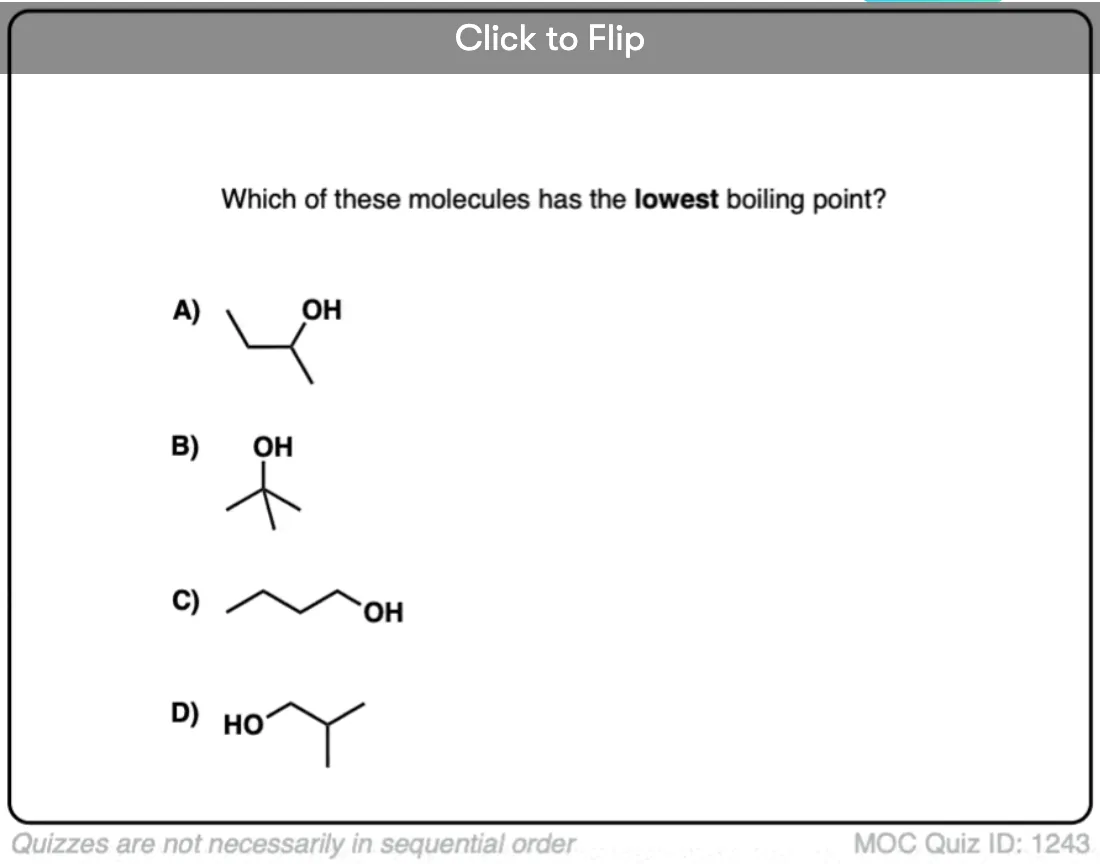
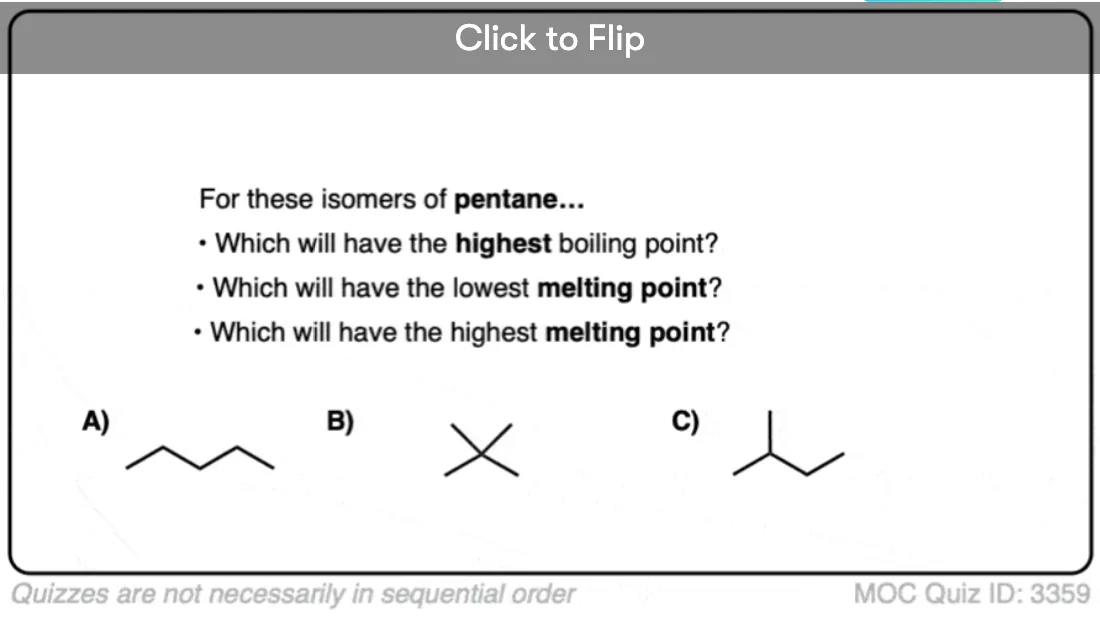
- Generally, the linear alkane isomer in each series (e.g. n-hexane) will have the highest boiling point, and the boiling point decreases as branching increases.
- This is because the intermolecular forces in liquids are proportional to surface area (due to London dispersion forces), and branching decreases surface area.
- For melting points, increased symmetry results in higher melting points since the more regular an alkane “brick” is, the easier it is to stack.
- Relative to the branched isomers, the linear alkane isomer also tends to have a relatively high melting point since it is more symmetrical.
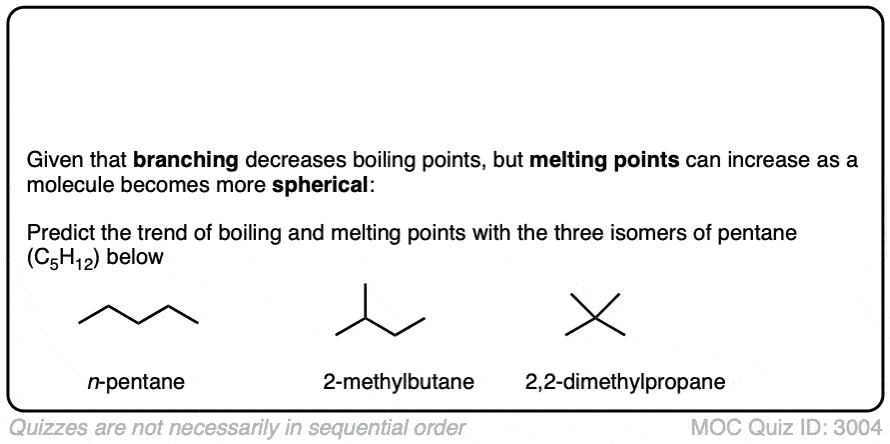
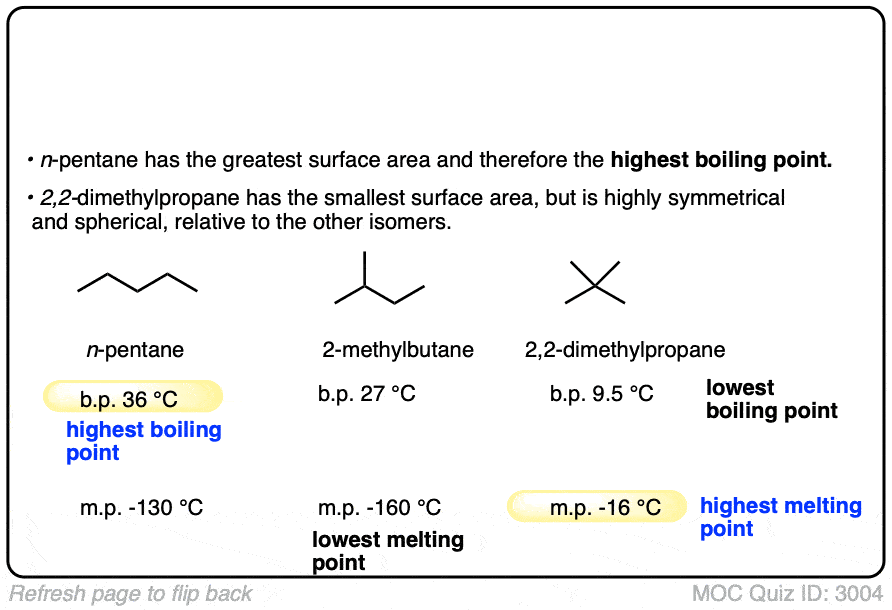
- However, with extreme branching can also come added symmetry, which can result in anomalously high melting points. One example is neopentane (2,2-dimethylpropane) which has a much higher melting point (-16°C) than that of pentane (-130°C).
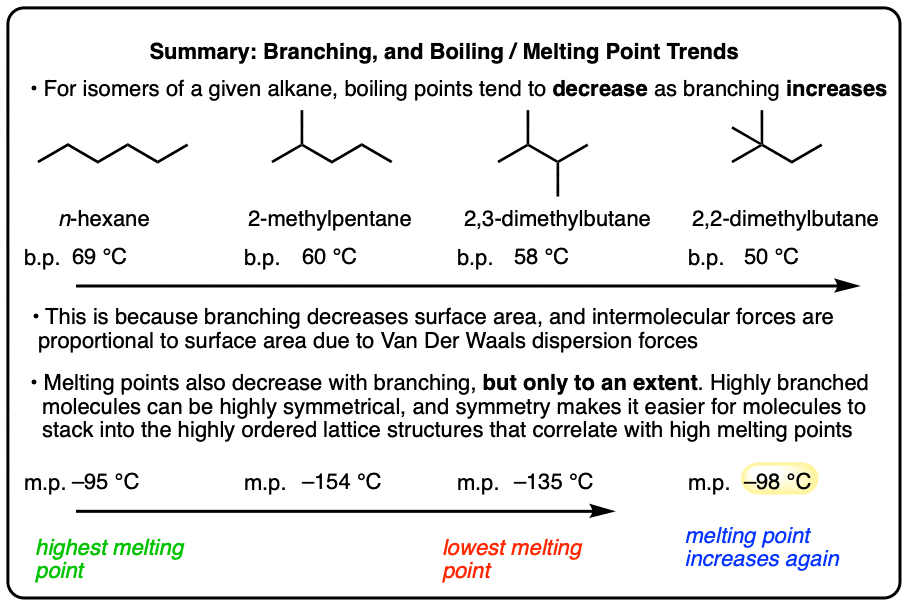
Table of Contents
1. Better Stacking = Higher Melting Points

The above photo shows what is perhaps one of the worst games of Tetris ever played. In my defence, the point wasn’t so much to play, but to take a photo of the great setup the Tech Model Railroad Club had set up next to the MIT museum, complete with a replica of the Green Building that you can play Tetris on. Truly the nerdiest place on earth.
Tetris is essentially a bricklaying game on a timer. You’re given tiles and you have to rotate them so that you make “lines” at the bottom, which promptly disappear when complete. If there are any spaces left in between, they remain – (for many examples, just look above). What makes Tetris hard is the arrangement of the different shapes. You often have to rotate them in order to get them to stack correctly.
If you want to make the game absurdly easy, just make it such that every tile looks like the one on the left. Or difficult, to the piece on the right.
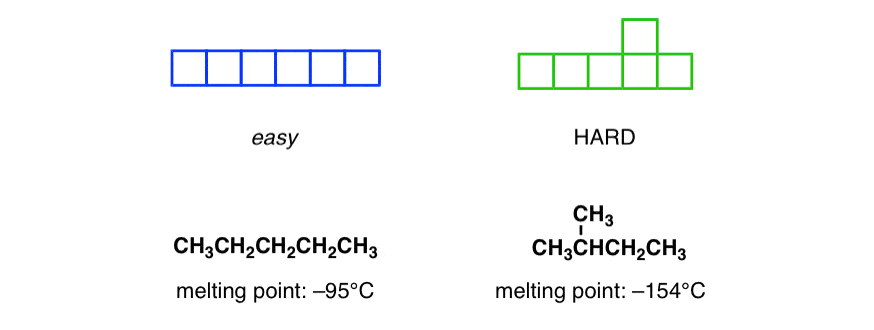
You’ll notice something – the simpler the pieces are, the easier they are to stack together, which provides a tighter fit with fewer spaces. Here, by putting a kink in the block, we make them harder to stack.
What’s this got to do with chemistry?
When compounds freeze, the process is a lot like stacking bricks. The more symmetrical the molecules are, the easier it will be and the fewer spaces there will be between the molecules. Fewer spaces = better stacking. Hence, when you compare hexane to its structural isomer, 2-methylpentane, hexane has a much higher melting point due to the regular arrangement of its structure.
Better stacking, higher melting point. Case closed. Right? Not quite.
2. Higher Surface Area = Higher Boiling Points
It’s a nice story: branching decreases melting point and boiling point. But it gets more complicated.
Look at these three examples of branched hexane derivatives (with hexane for comparison)
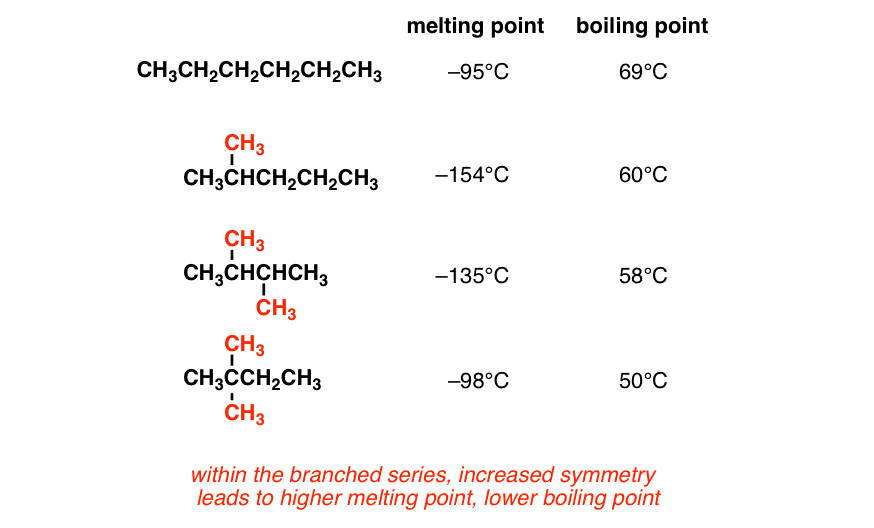
It looks like as we increase branching, we’re increasing melting point and decreasing boiling point. What’s going on?
Treat the n-hydrocarbon as a special case, and ignore it for the time being. Starting with the simplest branched compound, as you increase branching, you will increase the melting point, but decrease the boiling point. Why?
Going from “branched” to “highly branched” makes a molecule more compact and sphere-like. As the surface area of the molecule decreases (remember that spheres have the lowest surface area/volume ratio of any shape) they will become more compact and thus easier to pack. This explains the melting point phenomenon.
What about boiling point?
Boiling point is related to the forces between molecules, which in the case of hydrocarbons is Van Der Waals interactions. If you’ve ever seen microscope images of a gecko’s feet – which allow it to climb walls – you’ll see that there is no adhesive but the pads contain a tremendous amount of surface area. It’s all about the Van der Waals interactions.
As we decrease surface area, we are going to decrease intermolecular Van Der Waals interaction and therefore decrease boiling point.
3. The Key Relationships
So here are the relationships:
linear versus branched —> higher melting/boiling points due to better stacking and surface area contact.
highly branched vs. branched —> more sphere-like –> better stacking –> higher melting point
highly branched vs. branched —>more sphere-like – -> lower surface area —> lower boiling point.
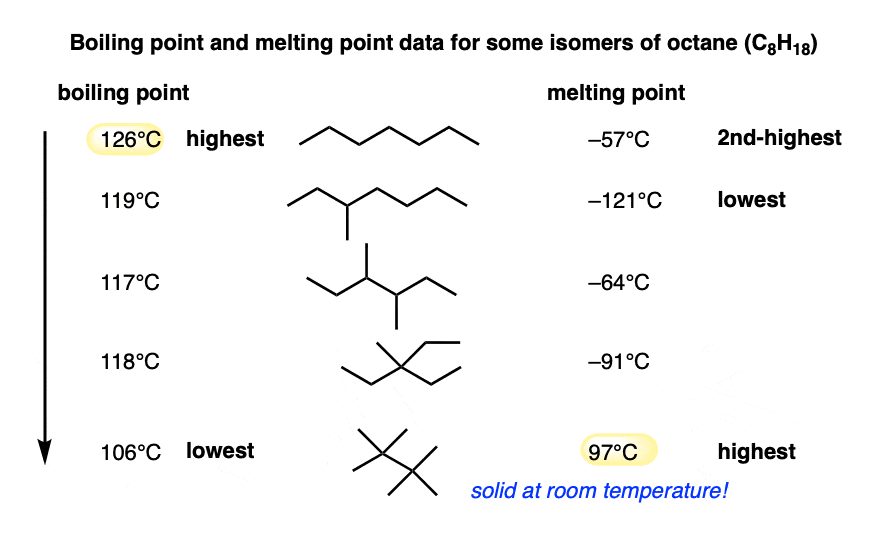
If this all seems rather ambiguous, contradictory, and imprecise, well, you have a point. It’s not a straightforward topic. As a final example, I give you 2,2,3,3,-tetramethylbutane. An isomer of isooctane (gasoline) with melting point 95 °C. Further proof, as if more was needed, that predicting melting/boiling points from chemical structures can be a fool’s errand.
 Click to Flip
4. Some More Experimental Data: Isomers of Heptane and Octane
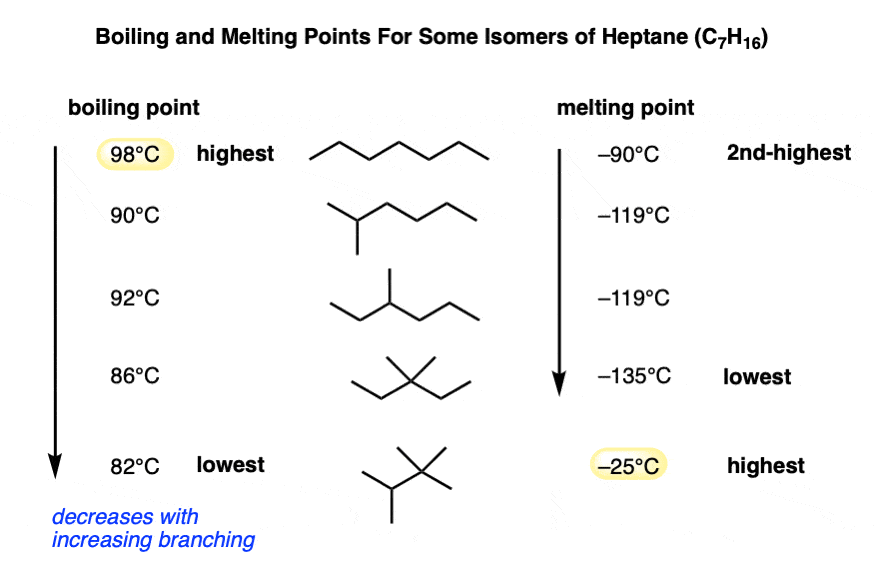
Looking at some experimental data, here are some isomers of heptane.
Note how the boiling point decreases as branching decreases (less surface area!) and the melting point also decreases with branching, but only to a point. The isomer 2,2,3-trimethylbutane has a higher melting point (-25°C) than linear heptane.
A similar phenomenon is observed for isomers of octane (C8H18). Note how the boiling points decrease with branching, but it’s a different story with the melting points. In particular, 2,2,3,3-tetramethylbutane is a solid at room temperature owing to its highly symmetrical structure.
Notes
Quiz Yourself!
Become a MOC member to see the clickable quiz with answers on the back.
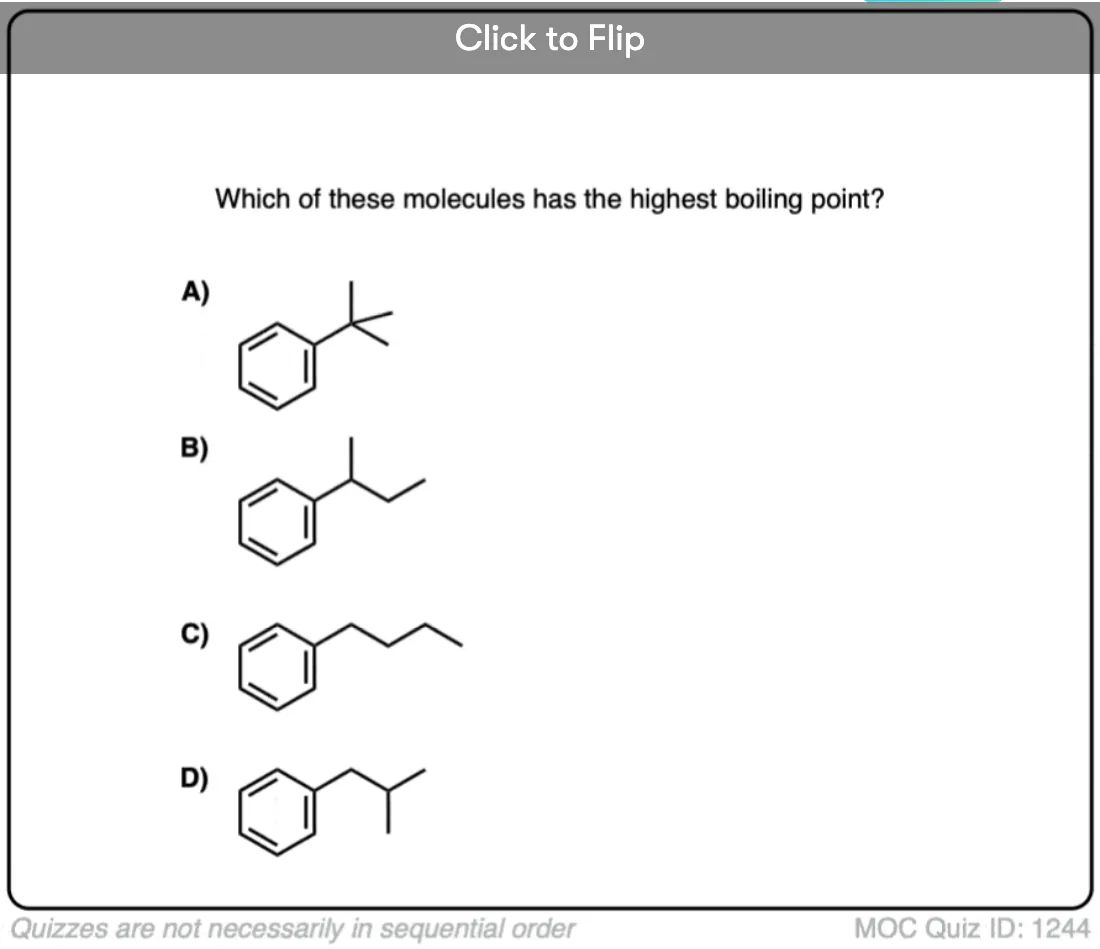
Become a MOC member to see the clickable quiz with answers on the back.
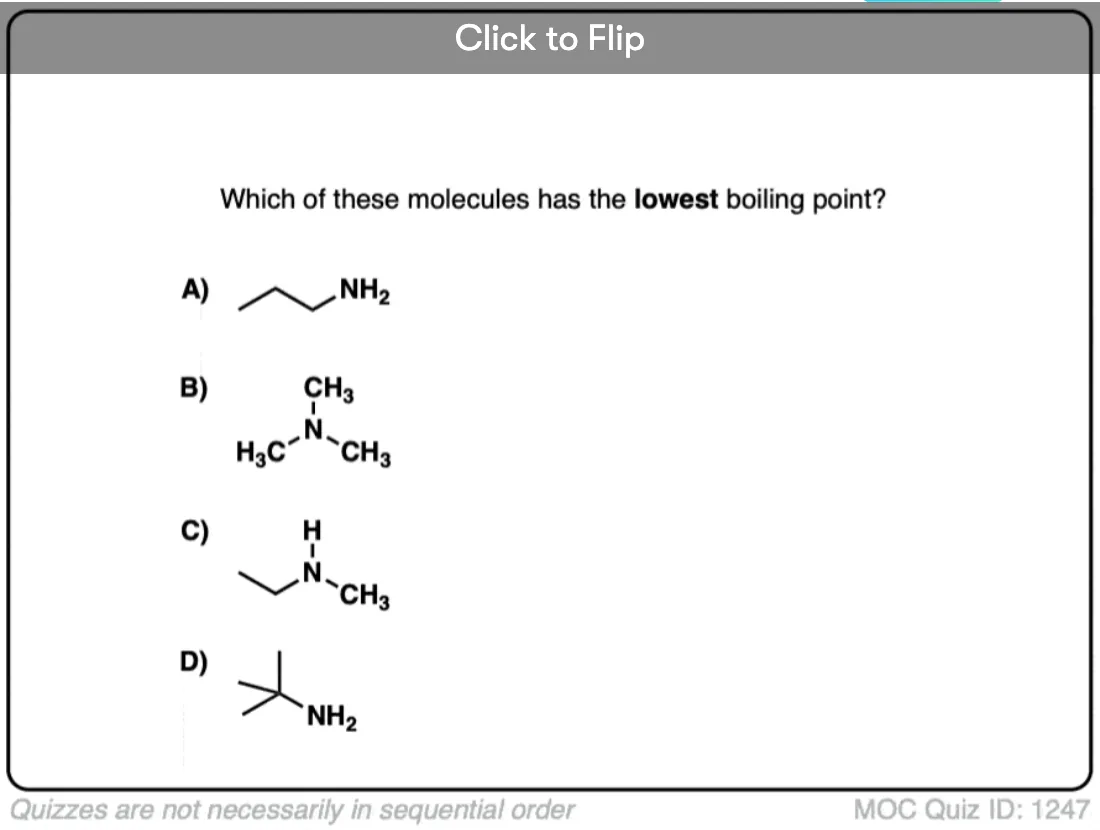
Become a MOC member to see the clickable quiz with answers on the back.
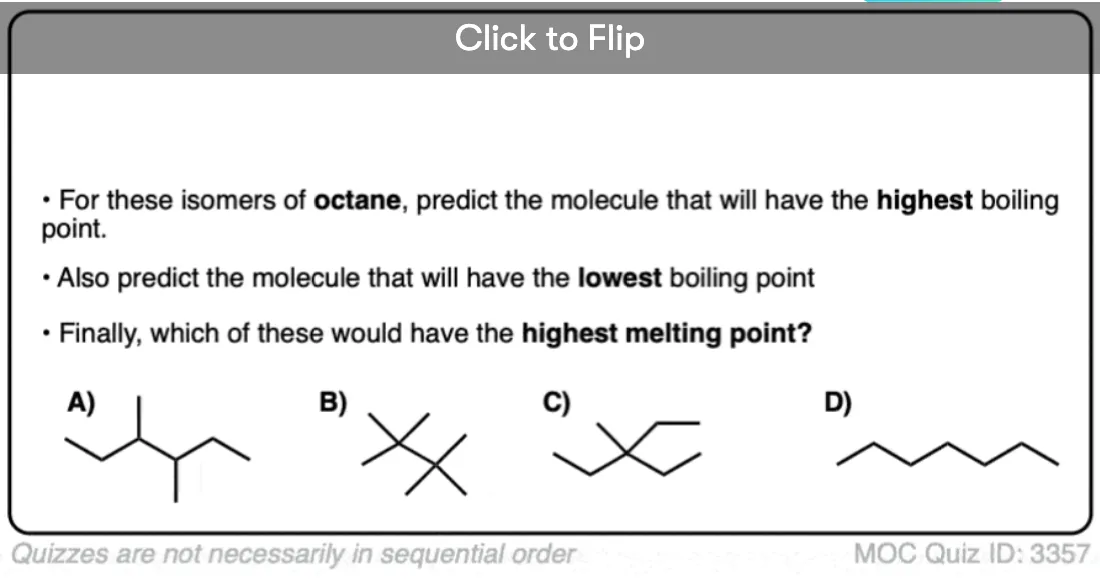
Become a MOC member to see the clickable quiz with answers on the back.
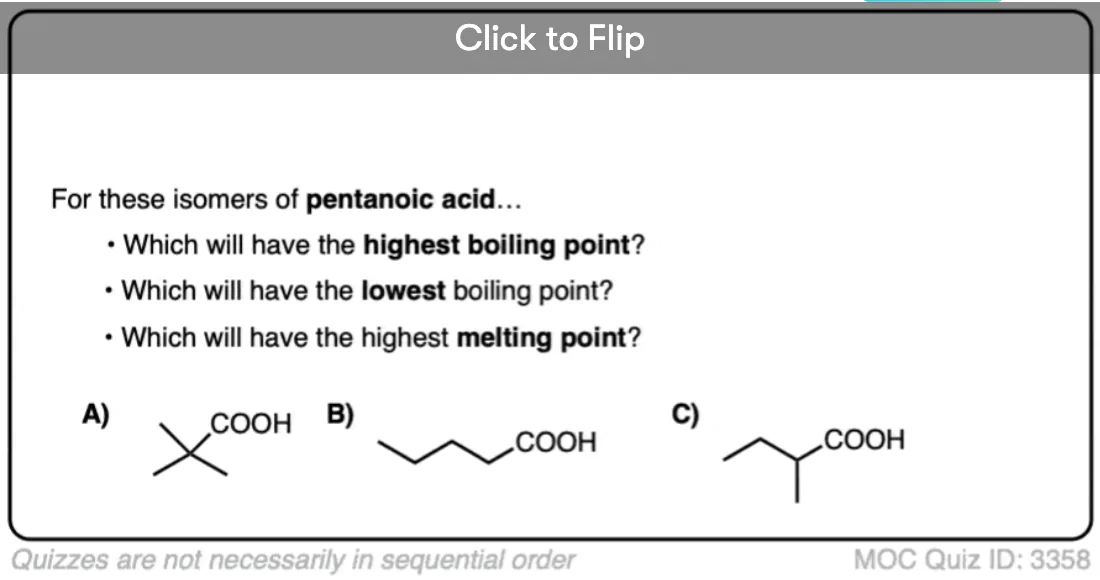
Become a MOC member to see the clickable quiz with answers on the back.
Become a MOC member to see the clickable quiz with answers on the back.
Find Master Organic Chemistry first when you search on Google:
How can it comes to relate between stability and bp and mp? I mean branched alkanes are known to be more stable than linear ones, but their bp and mp are lower than linear… why when the stability increases of these branched alkanes their bp and mp do not increase, rather they dercrease?
the comments are from 10 years !!!!! wow really wow I liked your way of explaining it and summerisied them here can anyone check them for me
i- the longer a hydrocarbon chain will create more surface for intermolecular interactions which will result in a higher melting point
ii- the better a hydrocarbon structure at stacking the higher its melting point:-
1- a linear chain will have a better stacking ability than a branched one
2- the less surface area in a branched chain the better its ability to stack (except for a liner chain)
3- a double bond will create a kink which will result in a sim-branched structure
4- saturated > highly branched > branched = unsaturated
Thanks for the nice and simple explanation, i was wondering why you would “Treat the n-hydrocarbon as a special case, and ignore it for the time being.”. Does this have something to do with the surface area and it being different?
Oh my god, this is such a beautifully simple explanation. I love how you guys make all of it so easy to understand. When I reached the end of the article, I was like, “Oh! That’s it?” Loved it.
So glad you found it useful Saujanya!
Thanks for the awesome website!
I have two questions:
1) Since better packing makes MP increase ,can we say that it alters lattice energy?
2)Why dont vanderwaals forces affect melting point?
Hi I just want to say thank you for such a clear explanation. I am a high school student who takes chem this year. Our teacher simply just told us to remember the rule without explaning it. After reading the article I understand the concept much better. Tks alot :D
hello,
I have a question; is it possible to add up two melting points of different substances, for instance: a solution (500ml) with a meltingpoint of 20C + a solution with melting point of 150C (10grams). i suppose that at a temperature of 30-50C will be good for this 10grams to dissolve completely ??
any suggestions’?
Melting point is a property of solids, not solutions – so I don’t know how to answer this question.
Sorry mp and bp lower
For branched to multiple branched doesn’t making more no of branched make it difficult to allign according to the Tetris explanation?therefore making the mp and bp higher
between co2 and propane which one have high melting point and why?
Those are completely different molecules. It’s hard to rationalize their different melting points because multiple variables are changing.
Dear James
why melting point of methane (-182) is higher than propane (-188)? , propane has higher molecular weight
thanks.
I think it’s because of the last point. Methane is more spherical in shape so can pack more tightly, increasing the mp.
Hello Dr. Ashenhurst,
Thanks for this entertaining and insightful website. I think that this is how organic should be taught. I like the way that you use analogies, life and other things to present the material. Communication is the key to understanding science. Many students fail because they simply don’t understand the language. Thanks for realizing that. I believe that we think alike on many levels.
Based on your example given (which was explained very nicely) we would expect n-pentane to have a hight melting point then neopentane, but that its just the opposite. So are the alkanes that make an almost “circle” like compound (such as neopentane) gonna have a higher MP then there straight chain isomer?
Or is this a special case based off the the fact that neopentane has a lower density and much lower entropy fusion then n-pentane.
Thank you for your help, know these stuff is an MCAT favorite.
Thanks for your highly organized explain with tetris! But I have one question that why symmetry affects m.p of a compound but not its b.p?
IReally Really want to know about this question! Plz reply or email me ASAP! thank u
Because symmetery is useless for liquids. We talk about symmetry only in solids as solids have definite arrangement of atoms. In liquids, the symmetry is useless as all molecules are in random motion within the liquid. Hence symmetry is absent in liquids, so bp is not affected by symmetry while mp is.
Thank You so much! The example you gave to make us understand was very effective. I am an Indian student preparing for IIT JEE entrance. So i need all the concepts crisp and clear. Thank you for your Help!
Thank you so much. I was wondering if you hadn’t will have a post on why melting and boiling point for alkane and alkene were different the way they were. Because I expected alkene to have higher melting point due to the double bond strength. Thank you!
You’re welcome! It’s a confusing subject, glad you found it helpful!
Jen – the double bond strength has NOTHING to do with boiling or melting point because the covalent bonds holding the molecule together internally do not break during a phase change. It is only the intermolecular attractions that are broken – a common mistake many students make.
Thanks for your highly organized explain with tetris! But I have one question that why symmetry affects m.p of a compound but not its b.p?
I really want to kbow about them. Plz email me asap!
thank you for your explanation, this helped me understand it quickly. I am an ohio state student getting ready to take the MCAT.
Thanks! Good luck, feel free to ask anything else!
Lets just keep tetris simple shall we :) Not with all these numerical numbers :) hehe
Just play at
http://www.mytetris.info
Hi I have one question , between a lineal saturated hydrocarbon and unsaturated hydrocarbon (double bond or triple bond) which one has higher boiling point ?
Another question :Toluene would be the most soluble in :
a) H2O b) NH3 c) CH3-O-CH3 d) CH3CH2
I can not decide between c and d ?
Well, the first answer must be strictly based on molecular weights. If the molecular weights are same, then I don’t know!
2nd answer would be d as it is the least polar compound.