Alkanes and Nomenclature
Summary Sheet – Alkane Nomenclature
Last updated: July 7th, 2023 |
Part of the problem with nomenclature is that the trivial names can cause a lot of confusion. By themselves, the IUPAC names are at least logical, if sometimes unwieldy – it might be a good plan to just stick to one system as much as possible.
I thought it would be worthwhile to put all the important rules for alkanes together in a new summary sheet. I’ve never been the biggest fan of doing nomenclature,, but sometimes when you don’t like something the best way to get over it is just to force yourself to do it.By the end it was actually kind of fun.
So here it is: Alkane Nomenclature (PDF)
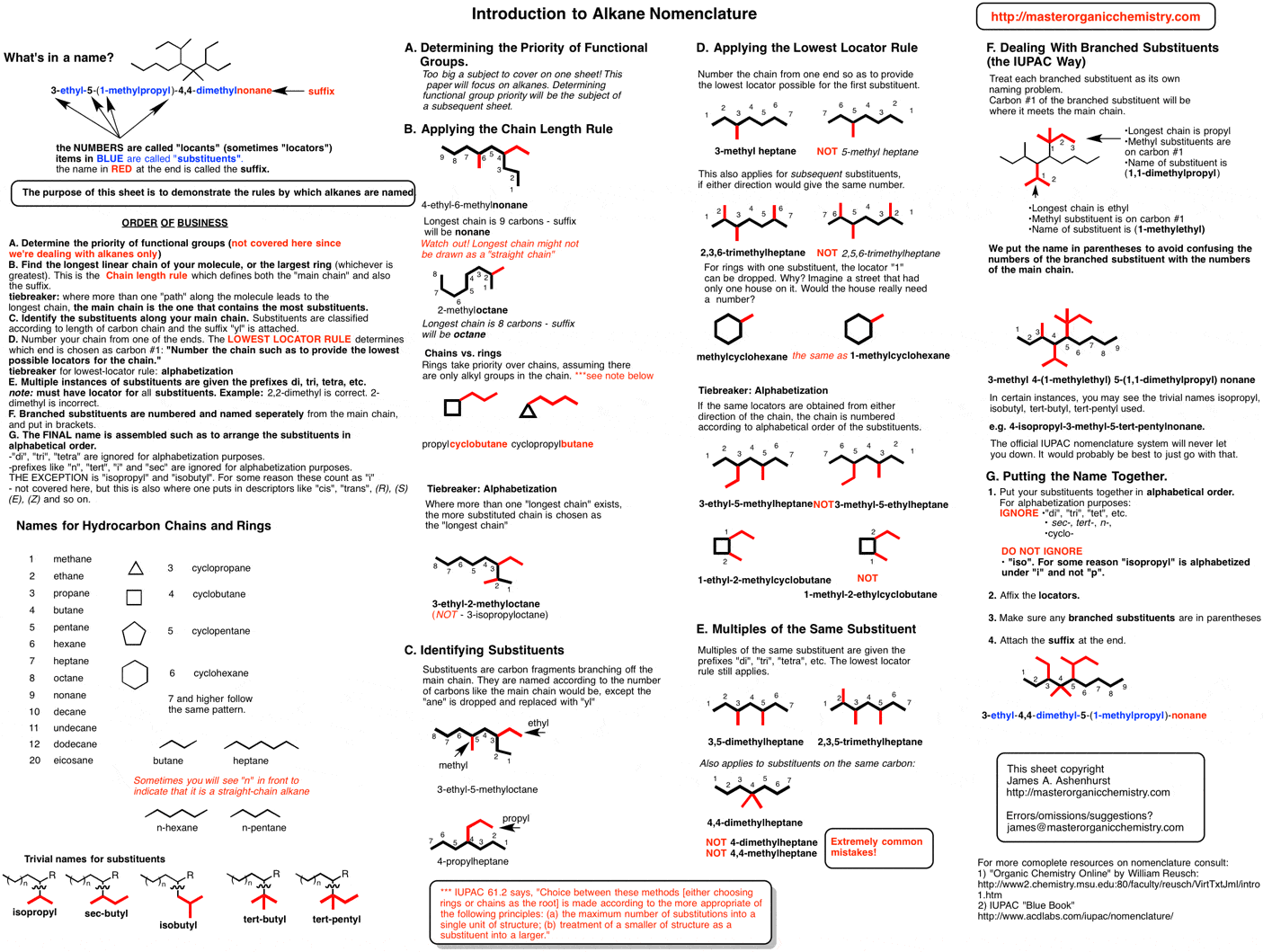
From the sheet, here are the 7 core steps for naming alkanes and derivatives.
A. Determine the priority of functional groups (not covered here since we’re dealing with alkanes only)
B. Find the longest linear chain of your molecule. This is the “Chain length rule” which defines both the “main chain” and also the suffix.
-tiebreaker: where more than one “path” along the molecule leads to the longest chain, the main chain is the one that contains the most substituents.
C. Identify the substituents along your main chain. Substituents are classified according to length of carbon chain and the suffix “yl” is attached.
D. Number your chain from one of the ends. The Lowest Locator Rule determines which end is chosen as carbon #1: “Number the chain such as to provide the lowest possible locators for the chain.”
-tiebreaker for lowest-locator rule: alphabetization
E. Multiple instances of substituents are given the prefixes di, tri, tetra, etc.
-note: must have locator for all substituents. Example: 1,1-dimethyl is correct. 1-dimethyl is incorrect. 1,1-methyl is incorrect. These are common mistakes.
F. Branched substituents are numbered and named seperately from the main chain, and put in brackets.
G. The FINAL name is assembled such as to arrange the substituents in alphabetical order.
-“di”, “tri”, “tetra” are ignored for alphabetization purposes.
-prefixes like “n”, “tert”, “i” and “sec” are ignored for alphabetization purposes.
THE EXCEPTION is “isopropyl” and “isobutyl”. For some reason the “i” counts for alphabetization here.
– This is also the point where stereochemistry prefixes such as “cis”, “trans”, (E), (Z), (R), (S) and so on are added.
——
As always any feedback, comments, clarifications, and omissions/errors in the sheet would be appreciated.
1) I believe that the “cyclo” prefix is ignored for alphabetization purposes, similar to how “di”, “tri”, etc. are ignored.
Thanks for the sheet James
Quick question: the example that you give in the top left-hand corner of the Summary Sheet #6 pdf, is it also correct to name the alkyl group on the 5th carbon as “sec-butyl” instead of “1-methylpropyl”? Or am I mixing things up?
Otherwise great sheets you have here! (I’m definitely buying the Org2 study sheets…) :)
Yes, 1-methylpropyl is also known as s-butyl !
One slight mistake on Summary Sheet #6:
On the “Trivial names for substituents” section, isobutyl is incorrectly drawn.
Source:
http://en.wikipedia.org/wiki/Butyl#Nomenclature
thank you! Will fix.
For simple cycloalkanes with simple alkyl substituents, the ‘half’ with the most number of carbons is the parent.
When one is more complex than the other, the ‘cooler’ half is the parent.
http://bit.ly/9lM1xg
I always thought that too. My version of chemdraw keeps spitting back the cycloalkane as the parent, however, so I was wondering if it knew something I didn’t. Haven’t found a clear answer for pure alkanes.
Bookmarked it., Thanks!
If you are learning the IUPAC nomenclature, it is always useful to test your suggested name. For this, one can use the online OPSIN service that translated IUPAC names into chemical structures:
http://opsin.ch.cam.ac.uk/
3-ethyl-2-methyl-3-propylhexane