Home / Putting Diels-Alder Products in Perspective
Organic Chemistry Tips and Tricks
Putting Diels-Alder Products in Perspective
Last updated: January 23rd, 2024 |
One of the things I like about teaching is that it helps me realize some of the things I take for granted that newcomers find difficult. The other night I got this question.
How do you know to draw the Diels Alder product this way?
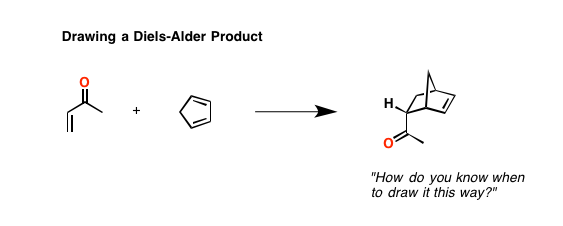
I’ve gotten so used to thinking of molecules in 3D that I’d forgotten that this could be confusing. The starting materials are drawn from a top view, while the product is drawn from the side. Why was it drawn this way?
Think of it this way. Why did the owner of this 1978 Ford Pinto (yours now for $4550, if you act fast) depict their prized vehicle this way?
 It’s a choice. There’s no one right or wrong way to show the car. He used the one that he thought gave the best view of it. He could have alternatively shown a picture of it from the front or the top. It’s still the same car, although a rear view might not be the best choice, which might remind buyers of the Pinto’s notorious sensitivity to backside attack.
Like cars and cats, molecules are 3-dimensional objects and looking at them from different angles gives different perspectives of their structures. It would have been equally valid to draw it like this:
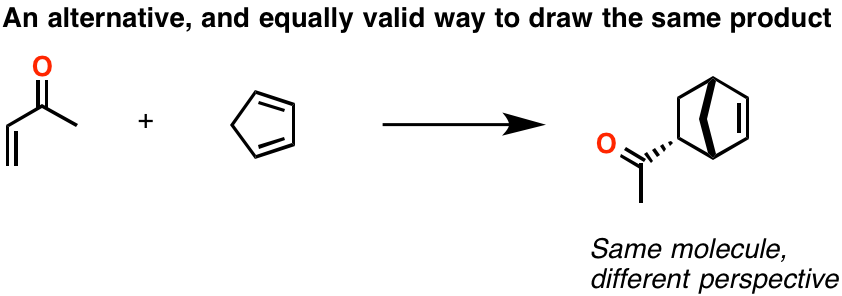
This is probably an eaiser way to visualize the molecule when you’re just getting the hang of these types of products, since everything is consistently from the top view. The side view (at the very top) just gives a slightly better perspective of the molecule in 3D.
If you make a model, this becomes a lot more clear.
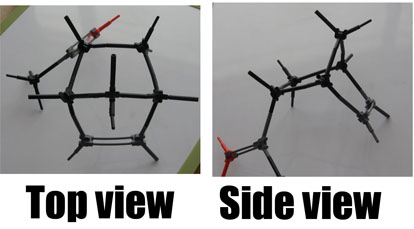
As you get more comfortable with organic chemistry hopefuly you’ll have an easier time thinking of molecules as 3-dimensional objects. As long as your drawing shows all the substituents in their proper places, however, it’s really your choice of which style to depict your molecules in.
00 General Chemistry Review
01 Bonding, Structure, and Resonance
02 Acid Base Reactions
03 Alkanes and Nomenclature
04 Conformations and Cycloalkanes
05 A Primer On Organic Reactions
06 Free Radical Reactions
07 Stereochemistry and Chirality
08 Substitution Reactions
09 Elimination Reactions
10 Rearrangements
11 SN1/SN2/E1/E2 Decision
12 Alkene Reactions
13 Alkyne Reactions
14 Alcohols, Epoxides and Ethers
15 Organometallics
16 Spectroscopy
17 Dienes and MO Theory
18 Aromaticity
19 Reactions of Aromatic Molecules
20 Aldehydes and Ketones
21 Carboxylic Acid Derivatives
22 Enols and Enolates
23 Amines
24 Carbohydrates
25 Fun and Miscellaneous
26 Organic Chemistry Tips and Tricks
- Common Mistakes: Formal Charges Can Mislead
- Partial Charges Give Clues About Electron Flow
- Draw The Ugly Version First
- Organic Chemistry Study Tips: Learn the Trends
- The 8 Types of Arrows In Organic Chemistry, Explained
- Top 10 Skills To Master Before An Organic Chemistry 2 Final
- Common Mistakes with Carbonyls: Carboxylic Acids... Are Acids!
- Planning Organic Synthesis With "Reaction Maps"
- Alkene Addition Pattern #1: The "Carbocation Pathway"
- Alkene Addition Pattern #2: The "Three-Membered Ring" Pathway
- Alkene Addition Pattern #3: The "Concerted" Pathway
- Number Your Carbons!
- The 4 Major Classes of Reactions in Org 1
- How (and why) electrons flow
- Grossman's Rule
- Three Exam Tips
- A 3-Step Method For Thinking Through Synthesis Problems
- Putting It Together
- Putting Diels-Alder Products in Perspective
- The Ups and Downs of Cyclohexanes
- The Most Annoying Exceptions in Org 1 (Part 1)
- The Most Annoying Exceptions in Org 1 (Part 2)
- The Marriage May Be Bad, But the Divorce Still Costs Money
- 9 Nomenclature Conventions To Know
- Nucleophile attacks Electrophile
Since I use chemdraw to do all my homework, how do I get it to draw it like that? If I manually draw it, and go to fix / clean up molecule, it changes the perspective. Can you offer some basic techniques on drawing organic molecules using chemdraw? Ways to draw conformations (newman/chair/etc as well)? I tried looking around and either get very basic, almost chem 1 style stuff that goes into basic alkanes with a few substituents or really complex molecules which is beyond the focus of orgo 1 and 2 (which btw, thanks to you, I passed orgo 1)
Chemdraw has a template for bicyclics. Under view -> templates -> bicyclics.
That should give you everything you need. If you need to move the bonds, use the little lasso tool and manually move them. If you need to add dashes and wedges, use the tool for that and correct it manually. Same with chairs. Newman projections you can do with the normal bond tool and a circle, if you don’t mind it giving you red squiggly lines.
If you look at papers from the mid 2000’s, you’ll see there is a heck of a lot of complexity you can add to some ChemDraw molecules if you try. It just takes a lot of time and patience. As well as that 3D swivel tool it has.
Thanks for stopping by! This is a really informative website! Some chemist friends of mine will love it :)
As for the cats, maybe you can adopt one or volunteer with a TNR program? :)