Organic Reagents
Reagent Friday: Sodium Amide (NaNH2)
Last updated: May 28th, 2026 |
Sodium Amide (Sodamide, NaNH2), A Strong Base For The Deprotonation Of Terminal Alkynes (Among Other Uses)
In a blatant plug for the Reagent Guide, each Friday I profile a different reagent that is commonly encountered in Org 1/ Org 2. Version 1.2 just got released this week, with a host of corrections and a new page index.
Note: there should also be another exciting announcement about the Reagent Guide coming up in the next little while or so… more details to come!
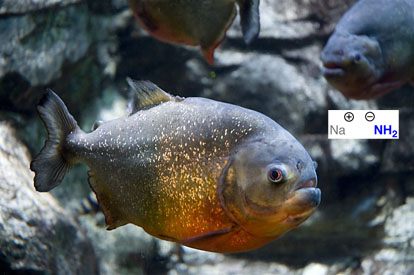
NaNH2 (Sodium amide)
What it’s used for: NaNH2 is a strong base. In the rare cases when its strong basicity doesn’t cause side reactions, it can be an excellent nucleophile It’s used for deprotonation of weak acids and also for elimination reactions.
Similar to: LDA (lithium diisopropylamide).
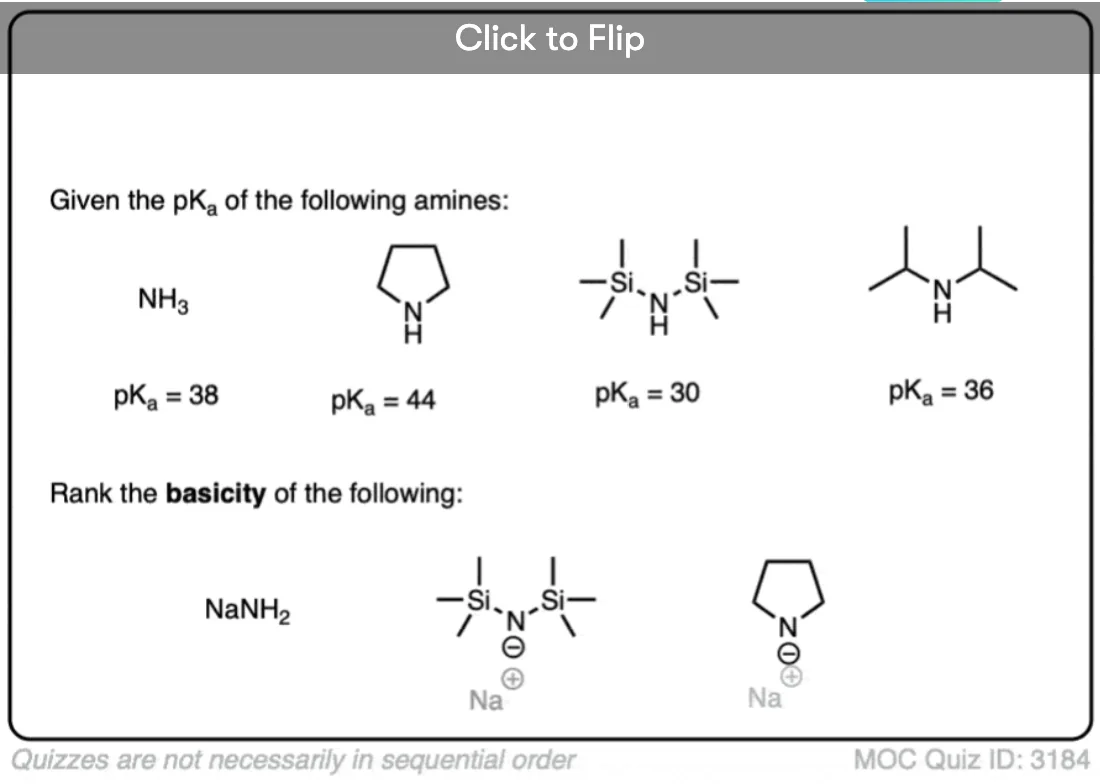
The NH2- anion is the conjugate base of ammonia (NH3). If you’ll recall, the weaker the acid, the stronger the conjugate base – and since NH3 has a pKa of 38, NH2 is a strong base indeed. (Note that although I’m talking about NaNH2 here, the bases LiNH2 and KNH2 essentially behave the same way.)
As a strong base, NaNH2 will deprotonate alkynes, alcohols, and a host of other functional groups with acidic protons such as esters and ketones.
As a base, it’s often used in situations where a strong, small base is required. Like a piranha, NaNH2 is small, fast, and has razor sharp teeth, and can find its way into tight, enclosed spaces.
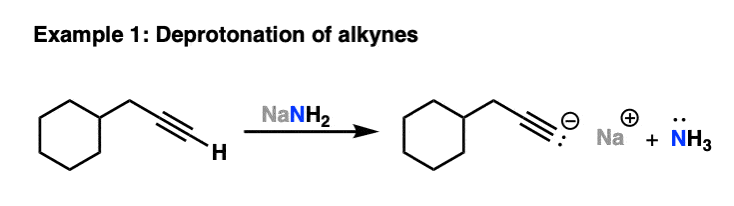
Sodium Amide (NaNH2) For The Deprotonation Of Terminal Alkynes To Give Acetylide Ions
One common application of NaNH2 is in the deprotonation of alkynes to give so-called “acetylide” ions. These ions are excellent nucleophiles and can go on to react with alkyl halides to form carbon-carbon bonds as well as add to carbonyls in addition reactions
NaNH2 As A Base For The Double Elimination Of Geminal Or Vicinal Dihalides To Give Alkynes
A second application of NaNH2 is in the formation of alkynes from halogens. Treatment of either geminal dihalides (i.e. – two halogens on one carbon) or vicinal dihalides (halogens on adjacent carbons) with NaNH2 (2 equiv) will result in the formation of alkynes.
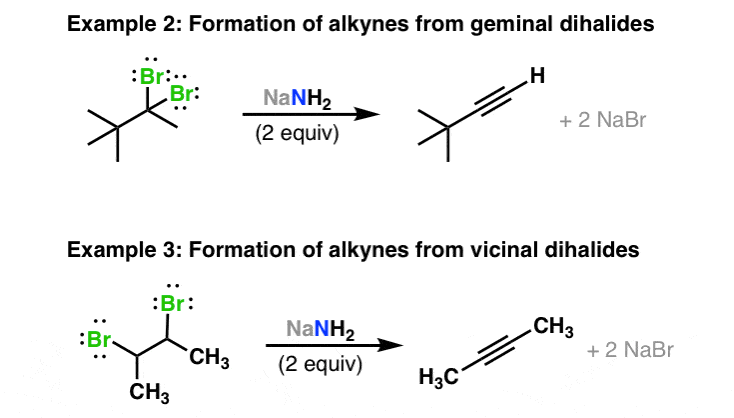
Since vicinal dihalides are easily made by the reaction of alkenes with halogens such as Br2 or I2, this is a useful way of converting alkenes to alkynes.
Mechanism Of NaNH2 : Double Elimination To Give Alkynes
How it works.
Deprotonation of functional groups such as OH and even alkyne C-H should hopefully be straightforward, but the use of bases to make alkenes may require some explanation. This is what is known as an elimination reaction, in that the elements H and Br (in this example) are removed in order to form the alkene. Specifically, this is an example of an E2 reaction.
Since the alkene still has a halide attached, this too can be removed to generate a second double bond (π bond). This is another example of the E2 in that the hydrogen has to be anti to the bromine that is eliminated, but is unusual in that it is an sp2 hydrogen that is affected here:
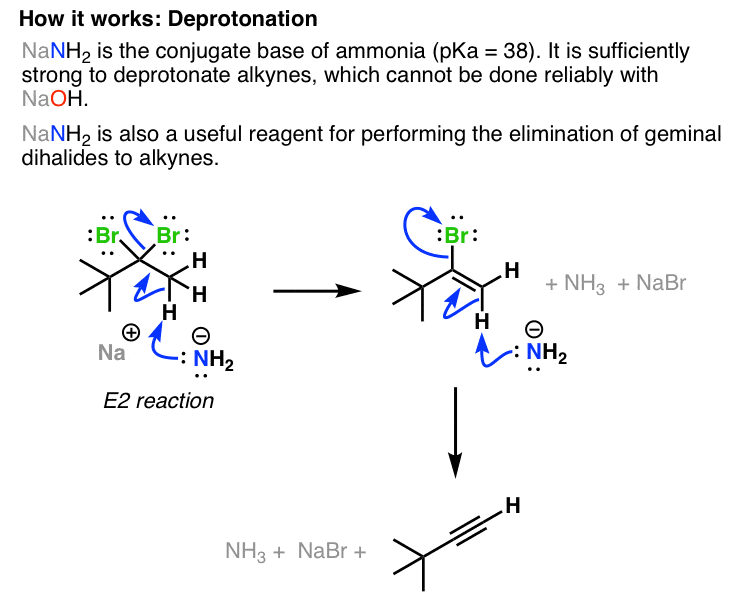
This arrangement is necessary in order for the reaction to occur in that the pair of electrons in the C–H bond that is breaking will simultaneously interact with the antibonding orbital of the C-Br bond, leading to formation of the new π bond and expulsion of the Br(-)
P.S. You can read about the chemistry of NaNH2 and more than 80 other reagents in undergraduate organic chemistry in the “Organic Chemistry Reagent Guide”, available here as a downloadable PDF.
EDIT/UPDATE. @chemistinjapan makes the following observation:

A note of caution on use of NaNH2 as a nucleophile. My trusty copy of March has the following to say:
“The conjugate base of ammonia is sometimes used as a nucleophile, but in most cases offers no advantage over ammonia, since the latter is basic enough.”
Furthermore, since NaNH2 is a strong base, it has the significant disadvantage of promoting side reactions from elimination (this can occur when attempting an SN2 with NaNH2 as the nucleophile, for example). Therefore, it is generally wise to avoid using NaNH2 as a nucleophile in organic synthesis. Sodium azide (followed by reduction) is the usual substitute.
I suppose one could use NaNH2 as a nucleophile in a case like this one (below) but again it offers no significant advantage over NH3:
Quiz Yourself!
Become a MOC member to see the clickable quiz with answers on the back.
Become a MOC member to see the clickable quiz with answers on the back.
Become a MOC member to see the clickable quiz with answers on the back.
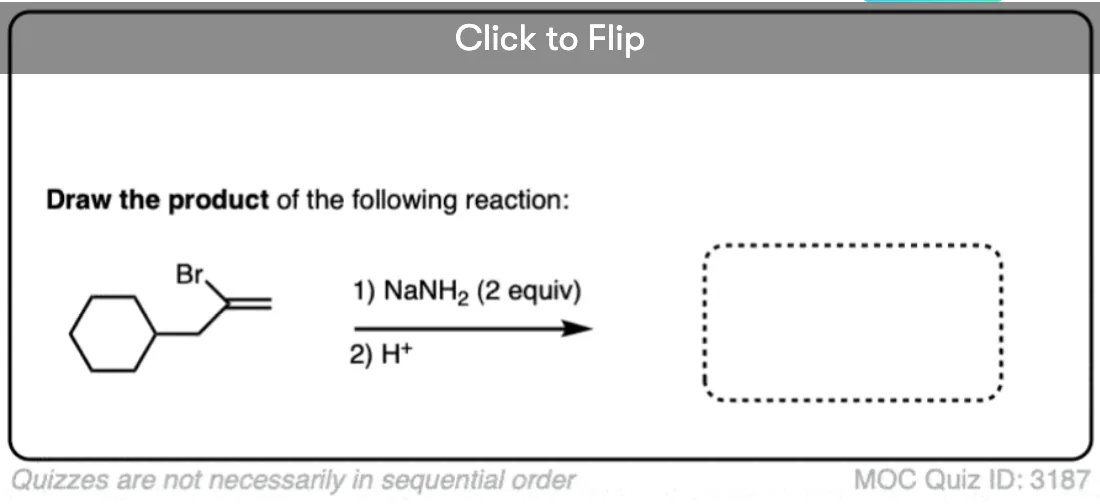
Become a MOC member to see the clickable quiz with answers on the back.
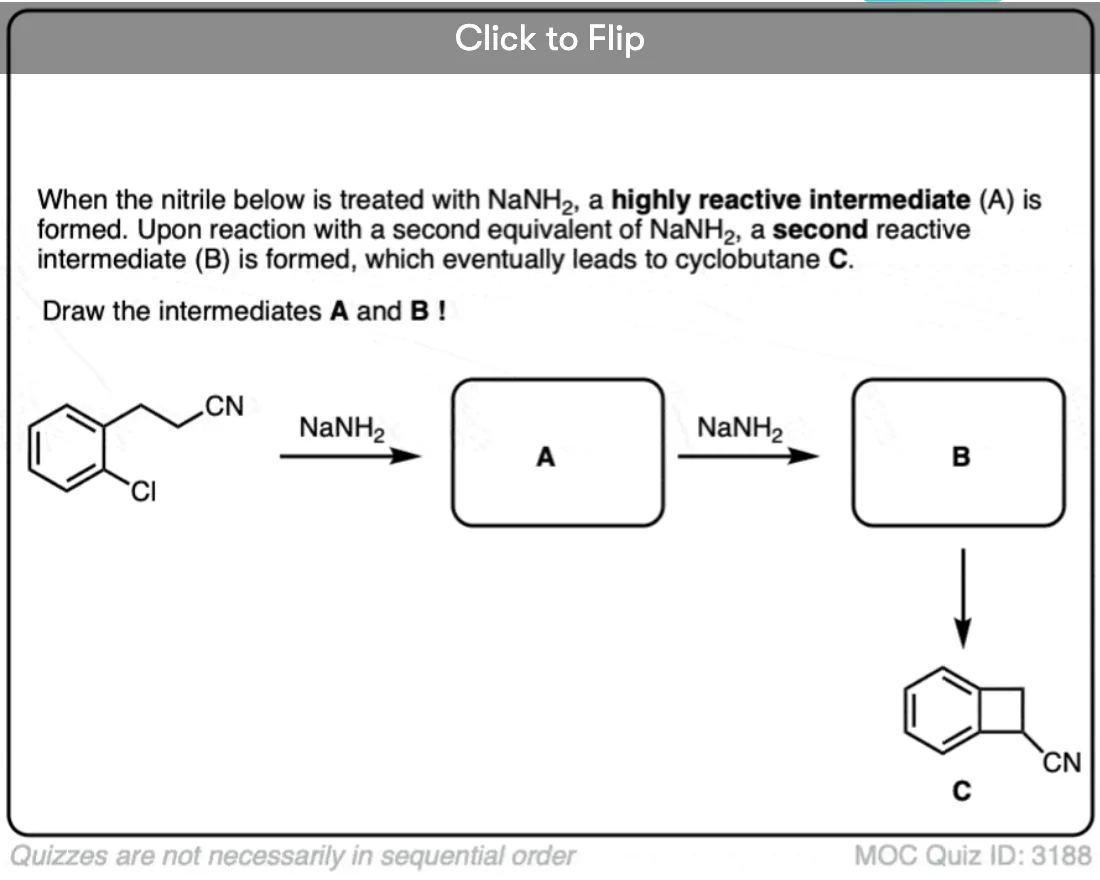
Become a MOC member to see the clickable quiz with answers on the back.
(Advanced) References and Further Reading
- SODIUM AMIDE
F. W. Bergstrom
Org. Synth. 1940, 20, 86
DOI: 10.15227/orgsyn.020.0086
How to prepare solid sodium amide, NaNH2, by passing a stream of ammonia through a crucible of molten sodium. From Organic Syntheses, a compendium of reliable procedures for the preparation of organic compounds. - Eliminations from Olefins
DR. G. KOBRICH.
Angew. Chem. Int. Ed. 1965 4 (1), 49
DOI: 10.1002/anie196500491
A review describing various types of a- and b-elimination reactions of alkenes to give alkynes. - Elimination Strategy for Aromatic Acetylenes
Orita, H.; Otera, J.
Chem. Rev. 2006, 106, 5387
DOI: 10.1021/cr050560m
Section 3.3 in this review covers the synthesis of alkynes by double dehydrobromination reactions from vic-dibromoalkanes. - Unsaturated eight-membered ring compounds. XI. Synthesis of sym-dibenzo-1,5-cyclooctadiene-3,7-diyne and sym-dibenzo-1,3,5-cyclooctatrien-7-yne, presumably planar conjugated eight-membered ring compounds
Henry N. C. Wong, Peter J. Garratt, and Franz Sondheimer
Journal of the American Chemical Society 1974 96 (17), 5604-5605
DOI: 10.1021/ja00824a066
The reaction used to synthesize the strained cyclooctyne is the double dehydrobromination reaction, using fairly standard conditions (KOtBu in THF). - Proton NMR study of two tetradehydrocyclodecabiphenylenes
Charles F. Wilcox Jr. and Karl A. Weber
The Journal of Organic Chemistry 1986 51 (7), 1088-1094
DOI: 10.1021/jo00357a028
The authors also use a double dehydrobromination reaction to obtain cyclic dialkynes, also using standard conditions (KOtBu in THF). The experimental section has detailed procedures.
Hello sir,
What if we react a haloalkene with NaNH2 like CH3CH=CHBr?
Hi again, thanks for the super valuable resource. I have some questions about the possible SN2 competition when doing the double-dehalogenation of a dihalide to form an alkyne. I would assume that -NH2 is a very good nucleophile; however, I also know that acid-base reactions tend to be faster (and since this reaction must be done at low temperature due to the liquid NH3, it would be under kinetic control, right?) So maybe that is one way that we prevent the SN2..? But then again, I’ve also been told that heat promotes the elimination product… so that feels like conflicting factors to me.
A related thought: would there be less SN2 competition with a geminal dihalide instead of a vicinal dihalide (due to sterics)? Therefore is it better to try to do this double-dehalogenation starting from a gem-dihalide? Thank you!
how to determine the assay of NaNH2
Hello James,
Thanks for the brilliant work
My query is regarding Example 3
If the mechanism is dehydrohalogenation, for each Br that eliminates, there are two beta C from which H+ can be eliminated. Then why But-1,3-diene is not a possible product?
please reply
Thank you for the part about the acetylide formation! Also I liked the piranha comparison xD.
Thanks for solving the doubt.
That is a great question. Unless you’re in an advanced class, I think the example you have should read NaNH2/NH3 since it’s a textbook example of elimination to give the acetylide.
That’s my short answer. Longer answer below.
——
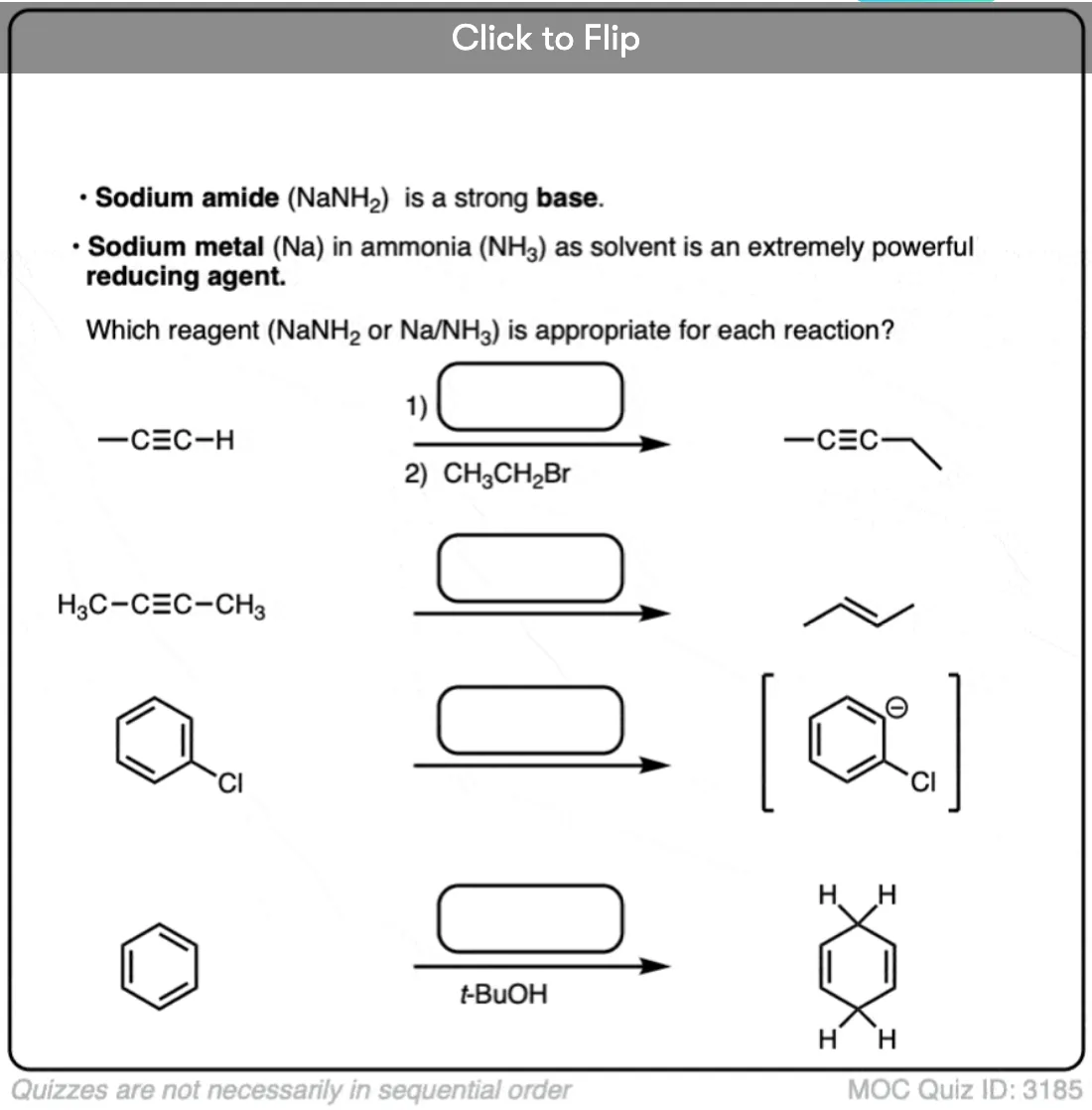
If I was writing a scheme where NaNH2 was used as a base in ammonia, I would write NaNH2 / NH3
If I was writing a scheme where sodium metal was used as a reductant I would write Na/NH3.
*As written* it suggests a reducing agent. Say 1-bromo-1-phenylethene was added to a solution of sodium in liquid ammonia. What would it do?
I think what it would do is reduce the C-Br bond to give an anion, which would then be protonated by NH3, giving styrene as the product.
Of course it would depend on how many equivalents of sodium you had, since if there were more, the aromatic ring in styrene would reduce further. However since no alcohol is indicated, it wouldn’t do a full Birch reduction and then there would be … a mess, to make a long story short.
In practice, to get NaNH2, it’s not enough to just add Na to liquid ammonia (Na/NH3) It helps to add a small amount of oxidant (like Fe(III) ) to get the process going that results in formation of NaNH2 (and formation of hydrogen gas)
“NaNH2 is usually made by dissolving sodium metal in liquid ammonia, so this is the most common reagent/solvent combination.”
If so, how will we solve 1-bromo-1-phenylethene + Na/liq.NH3 =?
Will Na/liq.NH3 work as a reducing agent and form 1-bromo-1-(cyclobuta-1,4-diene)-ethane?
Or will the so-prepared NaNH2 work as a strong base and form phenyl acetylide?
TLDR: If given reagent is Na/liq.NH3, how to know if to take it as the reducing agent Na/liq.NH3 or as the strong base NaNH2.
How does NaNH2 react with Substituted Benzene compounds ?
For eg –
https://hi-static.z-dn.net/files/d97/7ba9f763a7008724465f4814cf7ef723.jpg
https://imgflip.com/i/433uis
In the above NH2 (-) is added at meta position i.e. which has the MINimum electron density a/c to +R effect of OCH3.
In the 2nd link NH2(-) is once again added to meta position which has MAX electron density due to -R effect of NO2.
I am not able to figure out what exactly is happening here.Could anyone help me out ?
It occurs through a benzyne intermediate. See here: https://www.masterorganicchemistry.com/reaction-guide/nucleophilic-aromatic-substitution-via-arynes/
Sir,
Is the reagent NaNH2 (in liq. NH3) same as this one or are they both different ?
NaNH2 is usually made by dissolving sodium metal in liquid ammonia, so this is the most common reagent/solvent combination. It is also possible to buy sodium amide (NaNH2) and use it in other solvents.
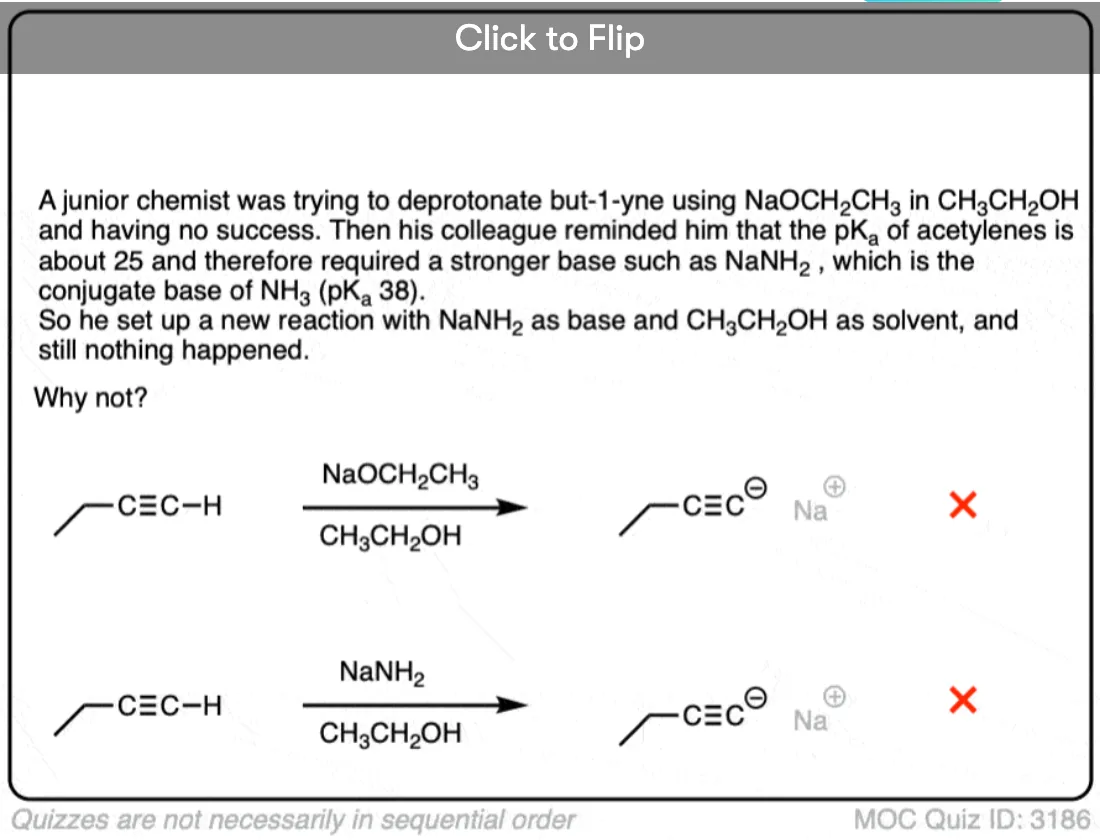
Why does the solvent have to be the conjugate acid of NH2-?
How come we typically include the NH3 along with the NH2-?
Thanks!
It’s the solvent (the conjugate acid of NH2- )
What about the reaction of the sodium amide with a phenol? Deprotonation takes place?
Yes, that’s it. Stronger acid (PhOH) plus stronger base (NH2-) gives weaker acid (NH3) and weaker base (PhO-)
sir NaNH2 it is removed acidic proton from ethyl acetate it is possible
Sure, NaNH2 will form the enolate of ethyl acetate, but it might also add to the ester. Why not use LDA?
What will I get when I add 2 equivalents of NaNH2/liq. NH3 to CH3-CH=C(Br)-CH3
For our purposes, you will get the internal alkyne, 2-butyne.
Ph-Cl + NaNH2/∆——–> ?
plz help…
Formation of an aryne.
In conversion of Alkynes from Vicinal Dihalides we use Alcoholic Potash (KOH) as Reagent in first step and then we use Sodamide (NANH2) in second step. Why can’t we use KOH in second step also.?
Why Sodamide is used in second step
KOH is not a strong enough base for the second step since you’re trying to do an elimination on an sp2 hybridized carbon.
I think example 2 is a bit misleading. Although two equivalents of NaNH2 can result in some of the alkyne, it is more typical to use three equivalents because NaNH2 can deprotonate the acetylenic proton. This distinction is only for terminal alkynes. Internal alkynes do not have this proton.
Hi James,
does sodium ethoxide (NaCH2CH3) has the same role as NaNH2, since they both can remove a halogen and for a pi bond instead ?
Thanks
PS: awesome website, it is very helpful !!
This summary for Sodium Amide (NaNH2) is amazing! Thanks a lot!
I wish to ask if there is a way to determine which reaction (Sn2 or E2) will a Sodium Amide (NaNH2) go though when comes to a primary alkyl halides?
We know if you have for example 1,2-dichlorobutane(Vicinal) reacts with three molar equivalents of NaNH2 in liquid ammonia then protonate, you will get an alkyne.
But it seemed a bit odd when Sodium Amide (NaNH2) goes through Sn2 when treated with for example 1-Bromoethane which gives secondary amine and then finally quaternary ammonium.
I’m also confused when Sodium Amide (NaNH2) seems to prefer Hofmann other than Zaitsev elimination even encountered with Vicinal alkyl dihalides to form alkynes.
Any insight would be greatly appreciated!
Thanks again!
Sir,
I came across a problem where NaNH2 on reaction with R-CH2-C(Br)2-CH3 gives
R-CH2-C≡CH instead of R-C≡C-CH3. If this is true, why doesn’t NaNH2 react the same way as alcoholic KOH ?
Please reply
Honestly, I really wish I had found this website earlier instead of 3 days before my final. These are by far the clearest and most helpful explanations I’ve ever found. Thank you!!
I had been searching the reagent for hours. Found it finally. The best post.:)
James,
I find it odd that NaNH2 can both react with an alkene to form an alkyne but ALSO react with an alkyne to form an acetylide anion. Since this is the case, if I reacted an alkene with excess NaNH2, wouldn’t the excess NaNH2 react with the alkyne I just created to form an acetylide anion? This seems like it would be an issue in cases of synthesis problems if I am not mistaken. Any insight would be greatly appreciated!
Many thanks,
Paul
YES – you are absolutely correct. When forming a terminal alkyl through elimination, in practice one must use 3 equiv of NaNH2 because if only 2 equivalents are used the reaction doesn’t go to completion.
Many instructors/schools are inconsistent on this point, and just mention “2 equiv” but you are absolutely correct.
https://www.masterorganicchemistry.com/2013/06/11/alkynes-via-elimination-reactions/
Hi,
I recently came across a problem involving acetylene reacting with NaNH2, NH3 followed by CH3-I
Is it possible for the base to deprotonate both sides of acetylene since there are two acidic hydrogens present? Or do we just assume one mole and treat it as an SN2 reaction.
Thanks
I’d assume that it deprotonates just one side of acetylene (1 mol of base) and reacts with CH3I to make 1-propyne.
Hope that answer gets to you in time! James
Thanks for this breakdown on this reagent. I was so confused on how to use something that’s a strong base AND a strong nucleophile, but your description of why NaNH2 is better served as a base really helped me out.
sir I want to ask if we use nanh2 with alkyl halide then substitution because of strong nucleophile should occur then why there is elimination.
Could you please tell me why is HgSO4 used in organic chemstry??Is it an oxidising agent or reducing one?? Moreover what is its action upon alkenes, carbonyl compounds and acids??
I know that HgSO4/H2SO4 is used in the oxymercuration/demercuration of alkynes (a hydration reaction) – instead of just acid catalysed hydrolysis, to avoid carbocation formation and so rearrangements. See here: https://chemistry.stackexchange.com/questions/40612/what-is-the-role-of-sulfuric-acid-and-mercuryii-sulfate-in-the-oxymercuration
Is sodamide the same as a sodium metal and liquid ammonia reduction?
No, the sodium in a liquid ammoniua reduction is sodium metal (Na). Sodamide is NaNH2.
Why NaNH2 is called as Sodamide even though it does not contain amide group?
“Amide” can be confusing. It can refer to either C(O)NH2 or NH2(-) . The name “Sodamide” comes from shortening the name SODium AMIDE.
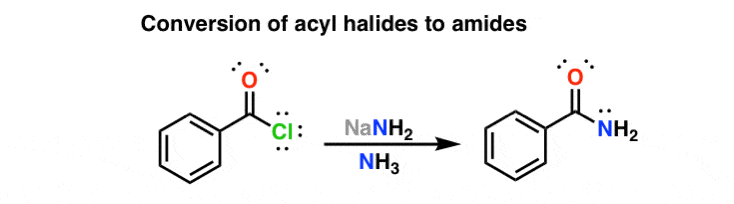
can you help me with the mechanism for the conversion of acyl halides to amides?
NH2- adds to the carbonyl carbon. Then, the oxygen lone pair re-forms a pi bond to the carbonyl carbon, leading to loss of the halide as a leaving group. Addition elimination.
THANK YOU SO MUCH. Your website is probably the most useful orgo website on the damn internet. I was trying to figure out how to use this stupid reagent for hours because my book doesn’t explain “how” it works and every other website just uses a ton of complex terminology to explain a simple concept.
thanks!
A lot better than my Klein textbook which took 10 or so pages to give a detailed reason as to why this happens instead of just being straight forward.
God bless you and Canada.
The best short summary of NH2- in solution I’ve found.
Just wanted to let you know I’m refeerencing this page in my Honours paper.