Alkene Reactions
Oxidative Cleavage of Vicinal Diols With NaIO4 and Pb(OAc)4
Last updated: May 28th, 2026 |
Sodium Periodate, NaIO4 As A Reagent In Organic Chemistry
In a blatant plug for the Reagent Guide each Friday I profile a different reagent that is commonly encountered in Org 1/ Org 2.

In organic chemistry, sometimes you need to build molecules up. Other times, you need to break molecules down. Ozone, which we talked about earlier, is a really useful reagent for that. Here’s another one, although it’s a little more obscure.
Sodium Periodate (NaIO4) Cleaves 1,2-Diols (“Vicinal” Diols) To Aldehydes And Ketones
Sodium periodate (NaIO4) breaks apart 1,2-diols (“vicinal” diols) to form aldehydes and ketones. In this respect it’s the same as periodic acid (HIO4) and lead tetra-acetate [Pb(OAc)4].
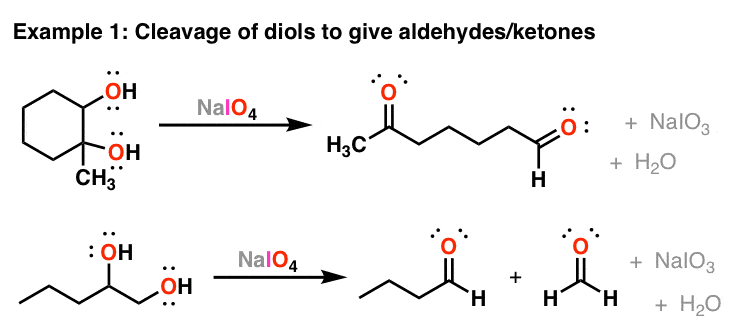
Notice what’s happening to NaIO4 here – it’s becoming reduced from iodine(VII) to iodine(V). In the process we’re cleaving a C-C bond and forming two C-O π bonds. Comes in handy sometimes, when you want to break apart an alkene and form aldehydes and ketones.
Cleavage Of Vicinal Diols By Sodium Periodate (NaIO4) – The Mechanism
The first step in cleavage of vicinal diols by NaIO4 is the direct attachment of the alcohols to the iodine. This occurs through two successive attacks of the iodine by lone pairs on each of the hydroxyl groups followed by a proton transfer.
In the second step, what happens is a kind of reverse cycloaddition (similar to what happens when an ozonide breaks down). This is a somewhat simplified version of the mechanism (skipping over the proton transfer). The key part here is the third diagram, where the cyclic iodate ester breaks down to give the ketone and aldehyde.
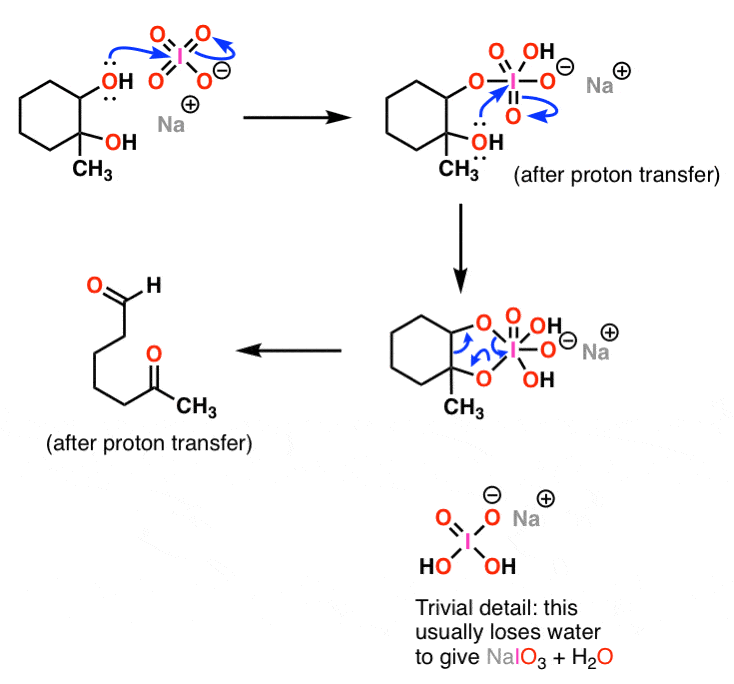
And there you go: aldehydes or ketones, depending on whether you’re breaking down secondary or tertiary alcohols (primary alcohols become formaldehyde). So this actually gives you a second way to cleave double bonds to alkenes/ketones besides ozone. You can take an alkene, treat it with osmium tetroxide (OsO4) first to make the diol, and then NaIO4 it. This is, incidentally, sometimes called “Johnson-Lemieux cleavage“. Obscure organic chemistry named reaction of the day!
P.S. You can read about the chemistry of NaIO4 and more than 80 other reagents in undergraduate organic chemistry in the “Organic Chemistry Reagent Guide”, available here as a downloadable PDF.
Quiz Yourself!
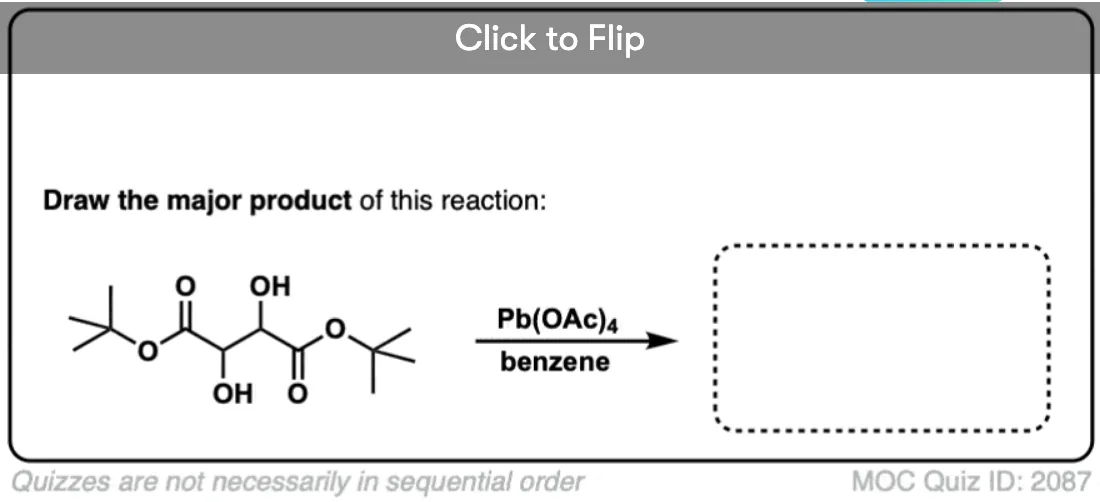
Become a MOC member to see the clickable quiz with answers on the back.
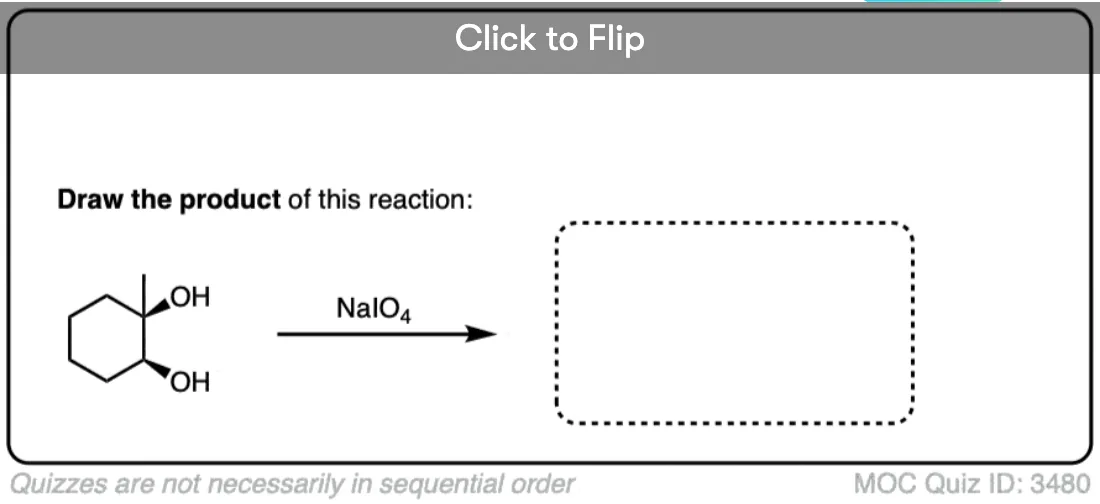
Become a MOC member to see the clickable quiz with answers on the back.
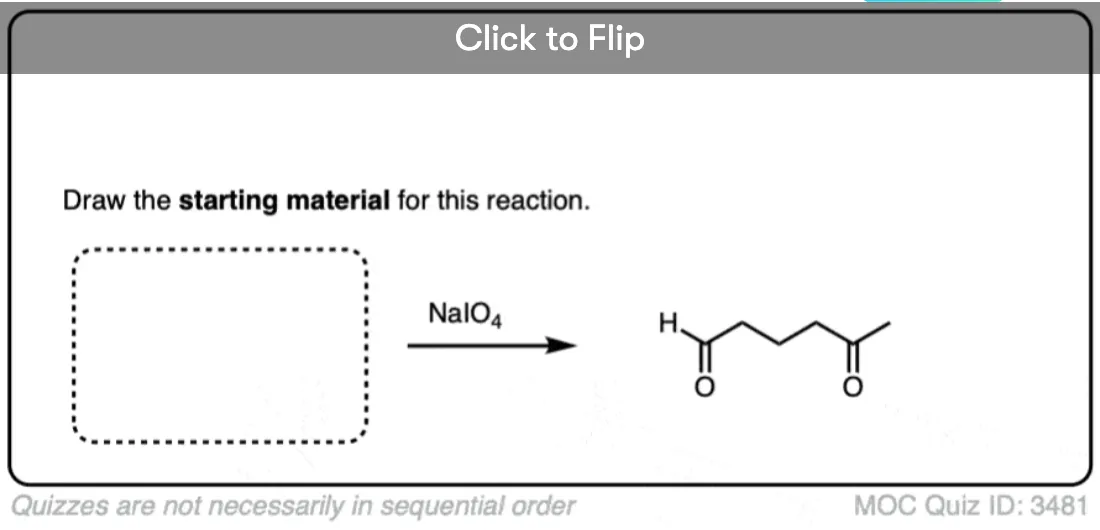
Become a MOC member to see the clickable quiz with answers on the back.
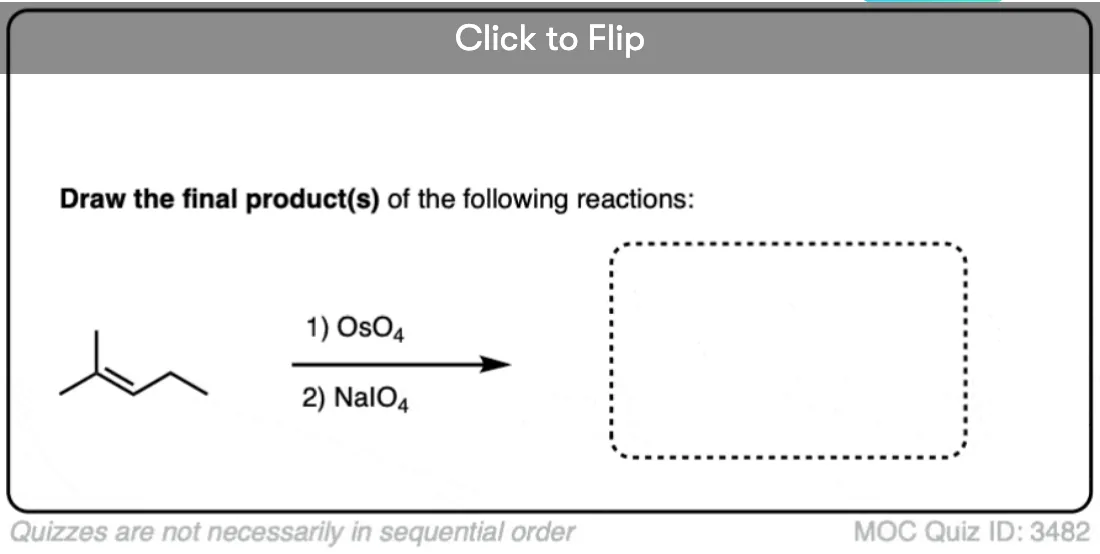
Become a MOC member to see the clickable quiz with answers on the back.
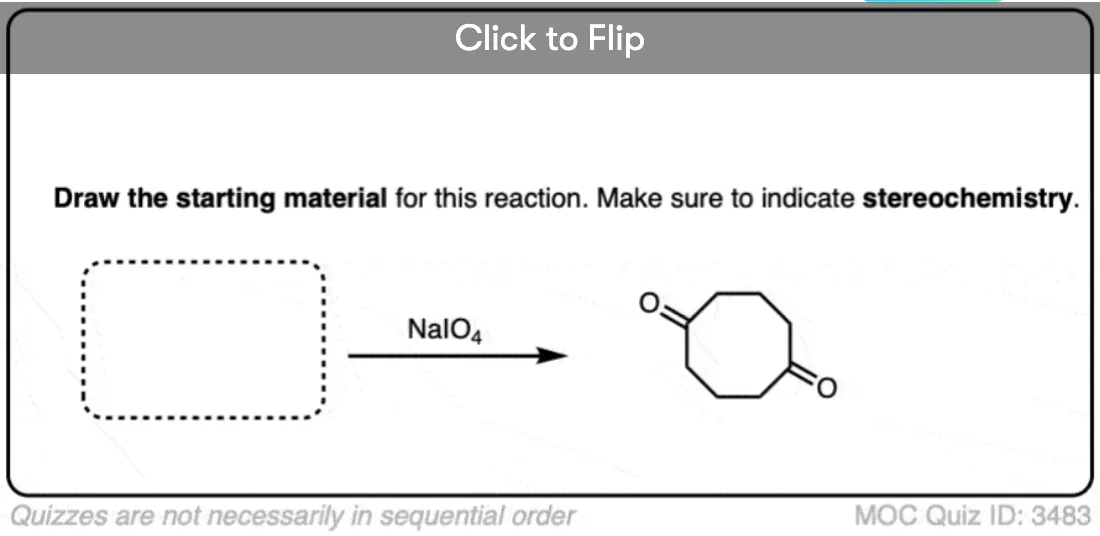
Become a MOC member to see the clickable quiz with answers on the back.
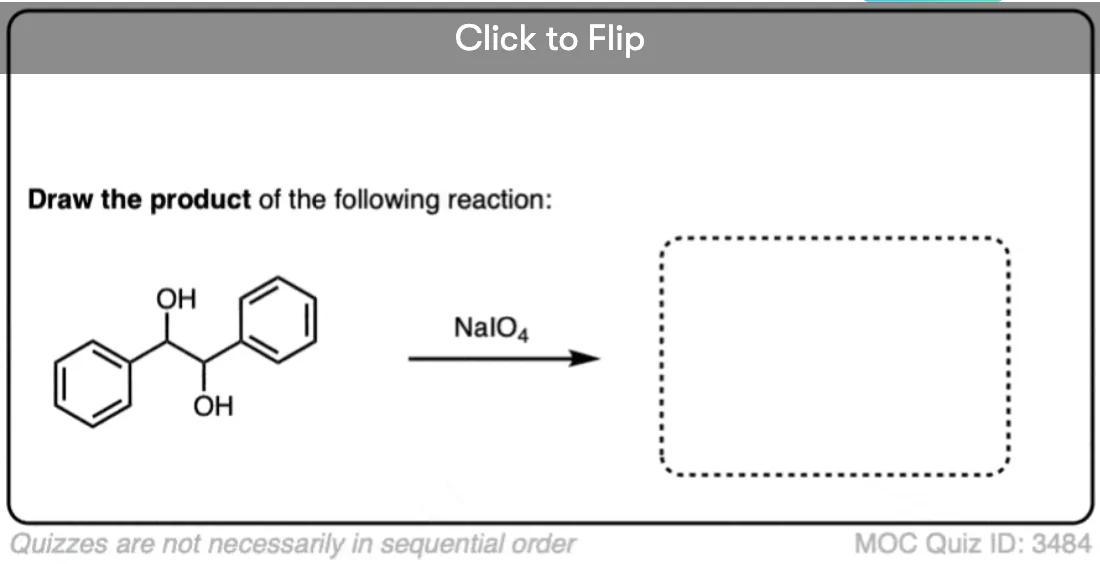
Become a MOC member to see the clickable quiz with answers on the back.
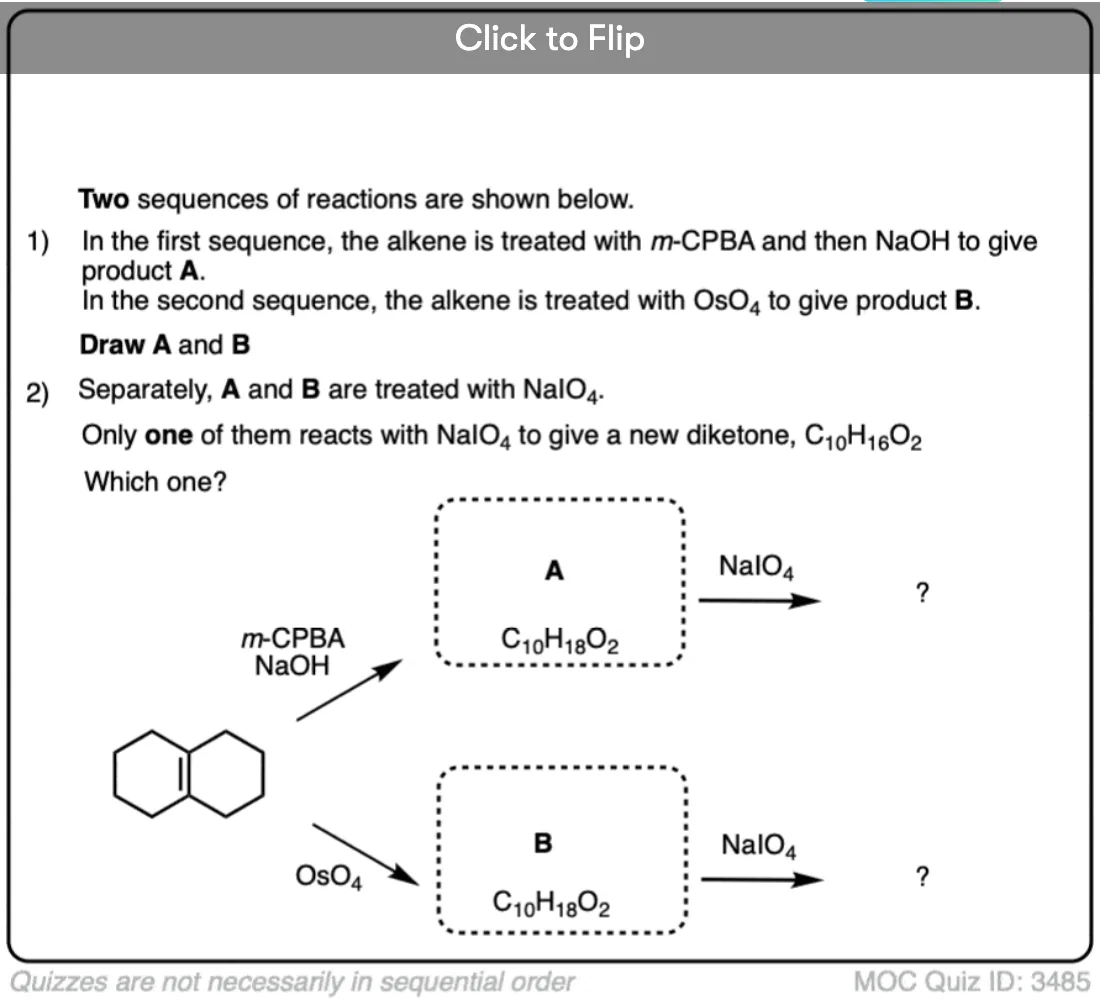
Become a MOC member to see the clickable quiz with answers on the back.
(Advanced) References and Further Reading
The most common oxidizing agents used for this reaction are KMnO4, periodic acid (Malaprade reaction), and Pb(OAc)4 (Criegee reaction).
- Malaprade, Bull. Soc. Chim. Fr. 3, 1, 833 1934
First paper on the oxidative cleavage of 1,2-diols, now also known as the Malaprade oxidation. - Chemoselective hydrolysis of terminal isopropylidene acetals and subsequent glycol cleavage by periodic acid in one pot
Wenlian Wu and Yulin Wu
The Journal of Organic Chemistry 1993, 58 (13), 3586-3588
DOI: 10.1021/jo00065a025
This can be considered a tandem or domino reaction – periodic acid unmasking a diol from an acetal and then oxidatively cleaving it in one pot. - Eine oxydative Spaltung von Glykolen (II. Mitteil. über Oxydationen mit Blei(IV)‐salzen)
Rudolf Criegee
Ber. 1931, 64 (2), 260-266
DOI: 10.1002/cber.19310640212
The first paper by on the oxidation of 1,2-diols with Pb(IV) salts, by Rudolf Criegee. - Direct Titration of cis-Glycols with Lead Tetraacetate
E. Reeves
Analytical Chemistry 1949, 21 (6), 751-751
DOI: 10.1021/ac60030a035
This reaction can also be used for the analytical quantification of 1,2-diols, as this paper describes. - Lead Tetraacetate Oxidations in the Sugar Group. XI. The Oxidation of Sucrose and Preparation of Glycerol and Glycol
Robert C. Hockett and Morris Zief
Journal of the American Chemical Society 1950, 72 (5), 2130-2132
DOI: 10.1021/ja01161a073
Pb(OAc)4 is commonly used as an oxidant in carbohydrate chemistry, as this paper describes. It is used to cleave 1,2-glycols and differentiate between different kinds of glycol groups. - (1’R)-(−)-2,4-O-ETHYLIDENE-D-ERYTHROSE AND ETHYL (E)-(−)-4,6-O-ETHYLIDENE-(4S,5R,1’R)-4,5,6-TRIHYDROXY-2-HEXENOATE
Fengler-Veith, O. Schwardt, U. Kautz, B. Krämer, and V. Jäger
Org. Synth. 2002, 78, 123
DOI: 10.15227/orgsyn.078.0123
A procedure in Organic Syntheses using NaIO4 oxidation in carbohydrate chemistry.
What should be the mechanism in case we have 1,2 diketo groups
Each of them add water to form the respective hydrates. Then the OH groups from adjacent hydrates coordinate to iodine and the oxidative cleavage proceeds from there.
actually my question was will the nai04 give same answer with ch3-o-ch2-ch2-oh?
No, no oxidative cleavage will occur. Both groups need to be OH so they can coordinate to iodine. If one of the oxygens is an ether, then no reaction will take place.
Sir, Can you also tell me what are the conditions (pressure and temperature) at which this reaction will be taking place.
Dear Sir, is this reaction possible in ch3-o-ch2-ch2-oh ? please help me out
That would not be a good solvent for an oxidant like NaIO4. I would use an inert ether solvent.
All of this is wrong……I am chem professor of very high level
All of it is wrong? OK!
Can periodic acid cleave trans diol in cyclic compound. Jerry and and march says that it can but how is it possible with the cyclic intermediate?
If the alcohols are both on equatorial positions, then it can be done.
Please propose mechanism for the below convertion
cyclohexane-1,3-dione react with Sodium periodate (NaIO4) in water(H2O) to farnish glutaric acid.
That doesn’t make sense. You’re missing a carbon somewhere. It can’t just be NaIO4, you’re likely treating cyclohexane 1,3-dione with OsO4 first.
Hey what if beta amino alchohols are cleaved with this… what are the products formed… please tell me
I don’t think beta amino alcohols can be cleaved. Only alpha amino alcohols. E.g. serine. https://pubs.acs.org/doi/abs/10.1021/ja01875a521
Can NaIO4 reduce the NH2 group vicinal to OH group?
Sorry not reduce, can it oxidise it?
Yes. NaIO4 will split amino alcohols, giving aldehydes in the process. See for example https://pubs.acs.org/doi/abs/10.1021/ja01875a521
So a general statement that can be made is:
Primary alcohols will give formaldehyde on reaction with Periodic acid
Secondary alcohols will give corresponding aldehydes
And tertiary alcohols will give a ketone.
Am I right? Pls help me out
If by “primary alcohol”, “secondary alcohol”, and “tertiary alcohol” you are referring to an alcohol that itself is adjacent to another alcohol group. Then yes.
That is really a great explaination sir. But is it only possible in the case of vicinal diols? What if more than more than two OH- groups are present side be side? What if there is =O group in between two OH groups?
Sodium periodate can also cleave alpha hydroxy ketones.
Thank you sir for this explanation. I had a doubt in a question which is as follows:
2(CH3)C=CH-C.3(CH3) ——— ( NaIO4/KMnO4 ) —-> Products?
What I thought was that first glycols would be formed by the presence of KMnO4 and then due to NaIO4 as you explained they would converted to aldehydes. But I checked the answer and one of the products was aldehyde but other was carboxylic acid. Can you please explain why and what happens in this reaction. Thank you.
The answer was: Acetone + 3(CH3)C-COOH .
[ Note: All the coefficients are at subscript position in front of that. ]
This is dihydroxylation followed by oxidative cleavage. KMnO4 is responsible for oxidation of the aldehyde to a carboxylic acid. The other product is a ketone.
Alternately, why can’t IO4- be used to directly form glycols from alkenes, which are then cleaved subsequently by it? Its structure is so similar to OsO4, why doesn’t it form the glycol in the first step as well?
Why doesn’t OsO4, which has a very similar structure to IO4-, also cleave diols?
i want to know about reaction mechanism of NaIO4 react with conc.sulfuric acid?
please clarify my doubt
NaIO4 with concentrated sulfuric acid should just form HIO4.
Wow! These reagent Fridays are so fun that I’m doing them on a Wednesday!
In the mechanism, one of the oxygens (double) bonded to iodine is missing in the 2nd and 3rd structure, I think. Otherwise, truly great work.
Fixed. Thanks for the spot!
I love Reagent Friday!
Just throwin’ this out there but have you considered Reagent Friday tshirts?? The reagent on the front w/ the mechanism on the back, or vice versa, or however you wanna do it- have a feeling they would sell. I mean how could a good organic chemist not look forward to wearing their Reagent Friday tshirt every Friday?
Or maybe a student could wear it every day and cheat on quizzes with mechanism problems by looking on the front of their shirt; heh, heh, heh. Not like I would do that.